A Relaxed Middle Way Between Realism and Constructivism
Andrea Christoph-Gaugusch
2019 (translated 2026)
Preface
I created this illustrated version of the attempt to theoretically develop a middle way between realist and constructivist modes of thinking as a psychologist with a focus on cognitive science. It is intended to assist readers of Philosophy of a Middle Way (Christoph-Gaugusch 2020) in their thinking, or conversely, to serve as an introduction to this philosophy.
I am interested in how I can describe human "perception," "language," "thinking," "memory," "attention," "consciousness" (and much more) as concisely and precisely as possible from a perspective that observes observations — a second-order cybernetics.
Some thoughts require space in order to unfold. Here I have given such space — externally expressed, written-down thoughts (even though we cannot literally see thoughts) — and to ideas, which may also take the form of images.
These pages are meant to show that philosophy can possess entertainment value. Wit opens thinking, and such openness is necessary if something new is to enter a system. Wherever we close ourselves off, nothing can enter. Yet nobody can be completely closed off. Thus I wish you much enjoyment in reading and viewing, and thereby in enriching my signs and images with meaning and significance here and now.
This text is written loosely enough that I treat it like an informal seminar manuscript and therefore make it publicly available. It nevertheless remains protected by copyright.
— Andrea Christoph-Gaugusch
A Brief Guide to (Philosophical) Disobedience
- Never believe anything that is written in philosophical books (or comics). Always examine it using your own intellect. Everything — including these seven principles.
- If something is written so complicatedly that you cannot understand it, that does not necessarily mean the fault lies with you. It may simply be nonsense — though not necessarily.
- Be especially critical when it comes to so-called "constructivism." Carefully examine the assumptions of different constructivist schools. Do certain assumptions repeat themselves? Then inspect them closely. Why do these thinkers need such fixed foundations? What purpose do they serve?
- Examine whether you have actually understood what you have read. Life itself reveals this. Therefore try to apply what you have read.
- If something is impractical, if it cannot be applied anywhere, then you can probably forget it again. Usually that happens automatically. But perhaps you simply need to attempt the application once more.
- If what you think you have understood benefits no one — or perhaps even harms someone — then it is useless. It is of no value in life.
- Does it speak not only of the devil but also of love? If not, then it is equally useless. It does not live.
On Cognitive Science
Fortunately, the "object of study" for psychologists is not merely the psyche. Rather, psychologists concern themselves with human experience and behavior.
When psychologists engage with philosophy — which apparently does happen from time to time — then such an elegant creature may even practice cognitive science: an interdisciplinary undertaking that spans many different branches of research.
Everything presented here emerged from reconstructive reflections within language. It is not empirical data that guides my thinking, but rather a reflexive gaze. Incidentally, this is very cost-efficient, because I can do it — think — anywhere and at any time, independent of institutions and research funding. Thinking costs no money. It is freely available to every human being.
That we are furthermore capable of investigating ourselves through thinking and observation — of engaging in reflection — is itself something that theoretically ought not be taken for granted.
If something reveals itself reconstructively in language, then it is only logical that it can also reveal itself empirically, since logical considerations ideally precede every empirical study. I lack the means for empirical studies and am not affiliated with any institute. Data that we obtain empirically must first be collected. They are subject to selective, observer-dependent choices.
A reflexive gaze within language operates in the very medium upon which every empirical investigation is founded. In this respect, I consider the insights gained in this way preferable to empirical data. This is the essence of philosophy — and fortunately for me.
Naturally, I can also attempt to calm my mind — my thoughts and feelings — to step out of language and thought. If I proceed in this way, I no longer have anything to say. I can no longer participate in discourse. Yet this is not necessarily tragic.
A Biopsychosocial Approach
In this work I consistently pursue a biopsychosocial approach. I illuminate realist assumptions within constructivist thinking that have always already been present in discourse without reflection, and by reflecting upon these assumptions I develop a middle way between realist and constructivist considerations.
Thus, within constructivist discourse, the existence of biological forms — a brain, a nervous system, a blind spot, and so forth — is always absolutely presupposed. If these realist assumptions are allowed to enter the discourse consciously, new and, in my opinion, highly practical possibilities emerge.
This work should therefore be read as a critique of "biological constructivism" — particularly the work of Humberto Maturana and Francisco Varela — and of all approaches built upon it.
I do not begin with a "nervous system" or a "brain" that invents, calculates, or constructs its realities. Rather, I reconstruct how we arrive at the knowledge that we possess brains and nervous systems (among many other things). This path is rarely taken, but I consider it highly exciting and illuminating.
Reflexive considerations in everyday language are the very steps through which this philosophy of a middle way emerges.
My primary focus is therefore not the brain or nervous system itself, but rather the communicative interrelations and the concepts through which realities emerge — and naturally these realities include nervous systems.
Contrary to common constructivist assumptions, yet in accordance with a second-order cybernetics (the observation of observations), I already regard the physical body as mentally shaped insofar as we have already observed it whenever we speak of particular parts — the nervous system, the brain, a cell, and so forth — or of the "body" as a "body."
At times, reading these assembled sentences may feel somewhat dizzying, but that is simply the nature of circular processes and of a philosophy without foundations. Everyone remains free to step out of my merry-go-round at any moment and perhaps eat cotton candy instead.
On the Here and Now
The so-called "here" and also the "now" are already subject to human distinction. An observer conceptually establishes the here (the context) and the now (the moment).
Some speak of a temporal window of approximately two to three seconds that we subjectively experience as "now." After about three seconds, we feel that, for example, one "click" no longer belongs to the previous "click." Everything occurring within two to three seconds, however, is perceived as "a Gestalt" (Pöppel 2000, p. 64).
We tend to exclude the significance of the here and now from psychological theories. Yet a concept only ever makes sense in the here and now. This also applies to concepts from cognitive science — thinking, memory, attention, concentration, and so forth.
Our models should be grounded in the here and now, because everything is always only here and now.
On Reading
Because reading has become second nature to us, we often overlook what an immense cognitive act it actually is.
We perceive something that immediately appears meaningful to us. We have learned rules regarding how a particular form is to be enriched with meaning and how these so-called "letters" are to be connected within the mind.
The letters, the signs, the drawn forms — they exist upon a background, a surface (paper, stone, screens, and so on) outside the observer, unless the observer is tattooed or has just swallowed a book (or a screen).
Signs become meaningful through observation — or through touch in the case of blind individuals.
Constructivist discourse rarely reflects upon reading. It is simply presupposed, just as signs themselves are rarely further deconstructed, even though such deconstruction is fundamentally nothing other than a reflection on reading.
But this omission is not limited to constructivist discourse alone. Reading itself is a prerequisite that is often overlooked — presumably because it appears entirely self-evident, especially within academic settings.
For this reason, philosophers often begin with signs and symbols, rather than asking how these signs and symbols become signs and symbols here and now.
This conceptual — rather than empirical — investigation forms part of the present work.
What Something Is
In order to follow this philosophy, it is not enough to remain merely "everyday" in one's thinking.
You must — and this truly is a must — attempt to increase the depth of your thinking.
Here is a brief guide for increasing the depth of thought. If you will, it is a staircase leading into the cellar rooms — in six images — which you may throw away as soon as you have arrived below and firmly locked the door from the inside. Perhaps this has already happened here and now.
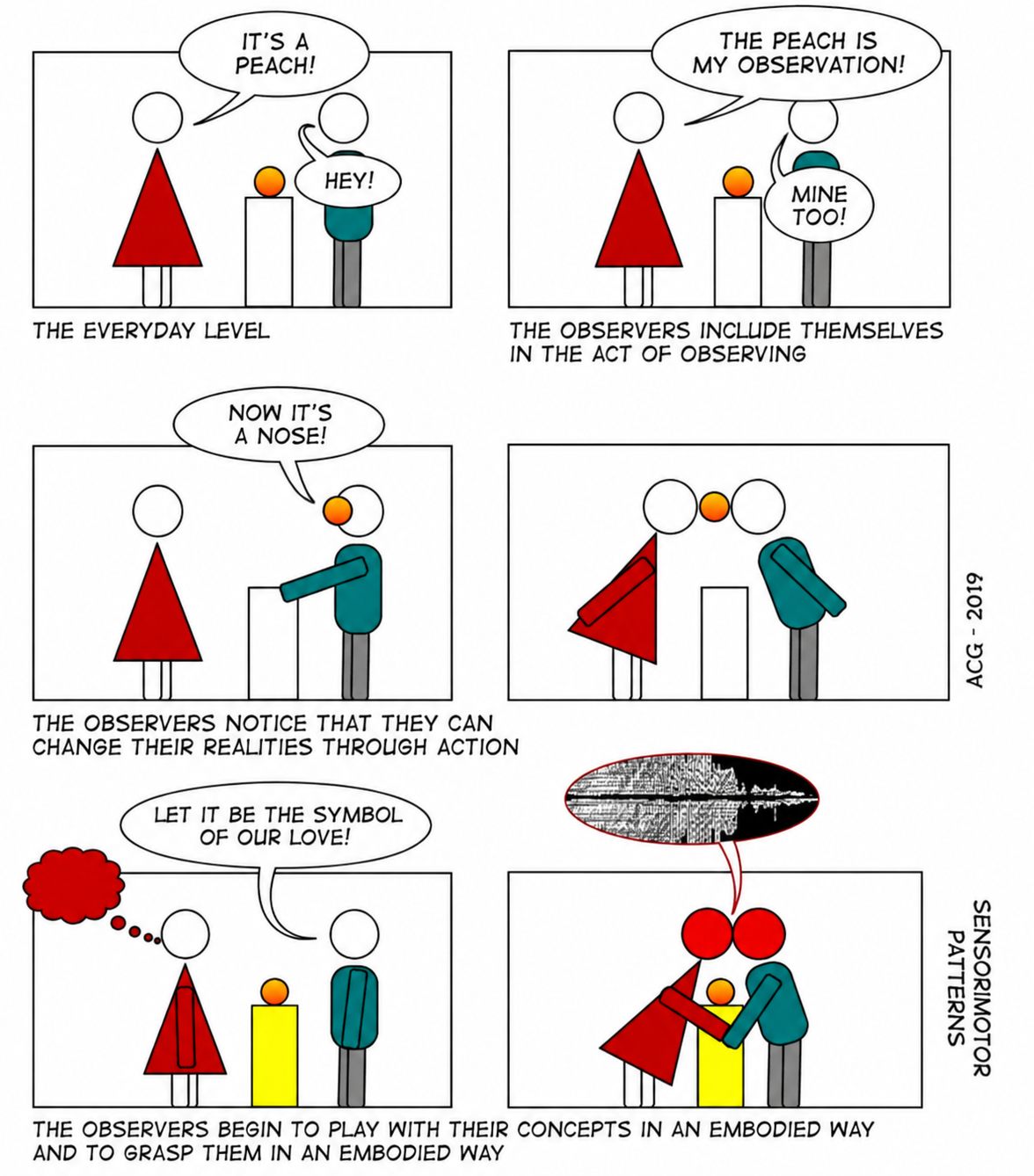
Basic Features of a Philosophy of a Middle Way
Radical constructivists such as Ernst von Glasersfeld and Heinz von Foerster — and all those who appeal to them — presuppose the observer and his or her biological form, especially the nervous system, as absolutely given.
Here I attempt to insert a reflexive loop, because these structures have already been observed and described — mentally and physically formed.
In my opinion, this is the key to a philosophy of a middle way that on the one hand assumes that observers linguistically construct and reconstruct their realities by conceptually grasping something as something, yet on the other hand does not remain trapped in solipsism and relativism.
For as observers, we cannot observe ourselves in a disembodied manner. The brain is, here and now, just as real as my left toe — provided someone saws open my skull slightly. And if this applies to my brain and my left big toe, then it must also apply to everything that can come into contact with me as an observer. I will attempt to demonstrate this through conceptual reconstruction.
In this way, as we go through this process, a middle ground between realistic and constructivist extremes should become apparent.
On Second-Order Cybernetics
Always keep in mind: the brain itself, as a brain, is also subject to the observation of an observer; otherwise, we would not speak of a "brain" at all.
The principle of conceptual comprehension applies to everything that is conceptually comprehended.
The expression "second-order cybernetics" goes back to Heinz von Foerster and "examines the interaction between the knowing subject and the object of its knowledge" (Simon 2017, p. 34). I would even go one step further and expand second-order cybernetics in the sense of an investigation into the observer's conceptual comprehension itself. In my descriptions, I do not presuppose the observer (myself, in this case); I do not even presuppose descriptions themselves. Rather, I attempt to conceptually reconstruct the emergence of the observer (that is, of myself) within my consciousness — to reconstruct descriptions themselves.
The game is simply meant to be played by two. Someone taught me the number one prerequisite for philosophical texts: the language I use here and now in a systematic way. I am still grateful to these people today. And they understood me, not as a pot or a gas can, but as a human being. They did so much more for me (hugged me, caressed me, told me stories…). Had they not done so, I would not be here now as a human being, to write this and reflect on my use of language. Second-order cybernetics reflects me back onto my observations (my conceptual understanding) and onto myself as an observer, allowing me to comprehend my own act of observing. A process of reflection that, in my view, is indispensable if one is to claim that all observation is observer-dependent.
(K1 - First Order Cybernetics, K2 Second Order Cybernetics)
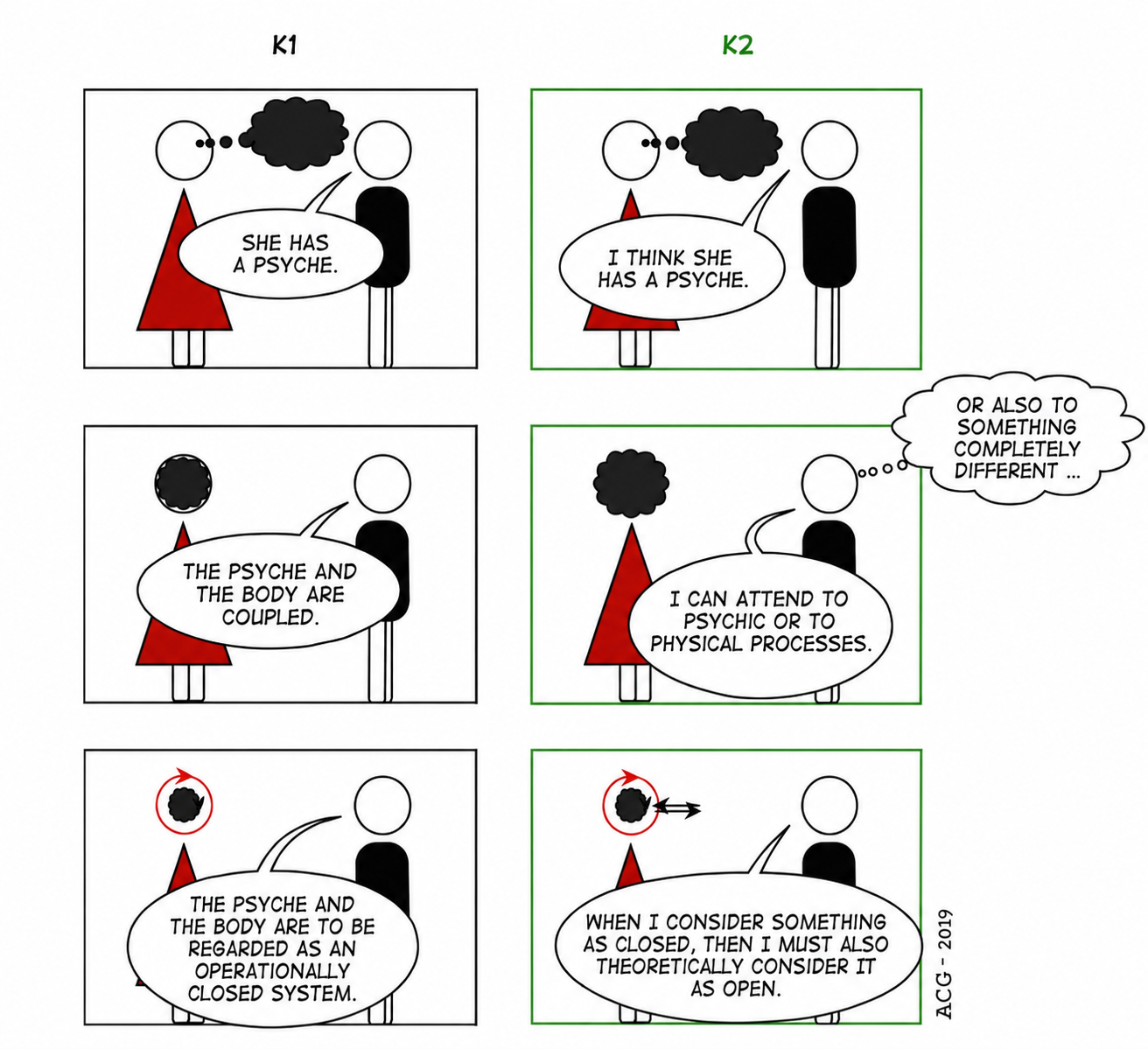
If we want to comprehend our own observing, then, in my view, we cannot avoid observing our observations — a self-referential mental operation that includes our observing within the act of observation itself. This is second-order cybernetics in the sense of Heinz von Foerster. It is not entirely trivial to conceptually include oneself as an observer within one's own observing, but it is certainly possible. In any case, if one practices this continuously for hours, weeks, or even months without interruption, it not infrequently causes headaches. It is easier to exclude oneself as an observer. Much easier. Much more comfortable. And much cheaper. For if I exclude myself as an observer, then my observations no longer concern me in any direct way. It really is that simple.
I can then maintain the opinion that what I observe exists absolutely. This is not entirely impractical. If it were impractical, this mode of thinking would not be so widespread. Yet scientifically it does not take us any further — at least not in the field of the cognitive sciences. If we wish to comprehend ourselves as observers (which need not necessarily be the case), then, logically speaking, we can only do so by including ourselves as observers within the analysis. Even if this is considerably more demanding. It is, however, extremely fascinating. And it is free of charge (thus even cheaper than cheap).
Second-order cybernetics (the observation of observation) is my "point of departure" — which, in truth, is no point of departure at all. Philosophizing without a foundation is like ice dancing. It requires some practice, but once one masters it, a sense of freedom begins to unfold. In life and in spirit alike. For here, nothing is posited as absolute; rather, everything is left within the context in which it always already exists. And since everything that is, exists only here and now, whatever presently is passes away almost as soon as I have comprehended it, merely to make room for new forms and configurations.
And yet, strangely enough, we repeatedly fall back into the very same linguistic grooves, generating again and again the habitual patterns we have learned — just as we repeatedly place one leg in front of the other. Entirely naturally and automatically. Without these ingrained communicative patterns, learned through rules and repetition, we would be incapable of making meaningful statements. We could not even comprehend ice dancing as such, nor freedom as such.
The "new" is always built upon the "old"; it builds upon already existing and previously learned patterns of behavior that have been trained since early childhood and that, in adults, have mostly become entirely self-evident. Just as I no longer think about how I skate once I have mastered it. We become accustomed rather quickly to what we have learned, especially when it concerns bodily movements that we perform continuously. But merely because we have become accustomed to something does not mean that we may simply accept it as self-evident within scientific and philosophical contexts.
If we investigate our conceptual comprehension — if we investigate those concepts that convey to us the image of a static world — then we cannot avoid examining the embodied movements that originally enabled us to learn concepts in the first place. For we articulated concepts aloud long before we learned to keep them silently to ourselves. And to articulate something aloud necessarily means learning embodied patterns of movement and touch (sensorimotor patterns), imprinting bodily forms within ourselves.
At some point it became self-evident how one articulates an A, E, or U. But just because something has become self-evident does not make it trivial. Moreover, the articulation of a sound always requires the embodied feedback of the organism that forms this sound here and now. It is therefore not to be regarded as an "absolutely existing pattern," but rather as a sensorimotor pattern dependent upon embodied feedback.
The philosophy of a middle way developed here has no absolutely posited foundation — not even an absolutely posited biological foundation. Rather, it is a philosophy that conceptually investigates processes and embodied feedback loops, without presupposing any absolutely existing "forms" (whether inner or outer). And in this way, this mode of thinking creates freedom, in my view. For when we bid farewell to the absolute, we bid farewell to all rigidity. We gain the freedom to think in processes — and that means always keeping transformation in view, in everything that may be the case here and now.
Freedom here means perceiving oneself as the driving force of a living dance, rather than being danced.
Philosophers do not fall from the sky. And if this is true for philosophers, then it is presumably true for all other human beings as well. Or perhaps I should say right away: human beings do not fall from the sky. The decisive question is always where we begin in philosophizing, which assumptions we establish, and whether we are even aware of these assumptions. In this work, I reflect within my language upon my own assumptions. This reflexive process simultaneously gives rise to a philosophy.
Since I reflect within my language upon my language and upon my observations within that language, what is taking place here is the observation of my descriptions and therefore the observation of my observations. In any case, I write here only about human beings, because I understand myself as a human being. I can only write about myself as an observer and about my observing within language; reflexively, I cannot investigate anything else here.
Of course, the term "to observe" can also be meaningfully used in entirely different contexts. One may also say that animals observe something, or that a robot observes something. The meaning of our concepts always depends upon the context in which we use them, and no one can be compelled to use a concept in only one context. This is part of the artistic freedom we human beings possess. Yet when we use a concept within a specific context, we should not overlook that context. In this sense, the use of our concepts is not arbitrary, since contexts cannot simply be exchanged at will.
And a context is, as a rule, generated intersubjectively, just as our conceptual systems presuppose intersubjective interaction. In this philosophical work, I therefore limit myself to human beings and to the investigation of human observing and describing. Since I — like many others — hold the view that only human beings use language, and since reflexive considerations within language interest me, that is, the analysis of conceptual comprehension, I do not consider it meaningful here to reflect upon the "conceptual systems" of foxes, mice, or tadpoles.
This does not mean that such living beings do not generate their own realities in accordance with their respective ways of being. It merely means that I, conducting a philosophical investigation within language, cannot say anything about this here. Which, in turn, does not mean that the investigation of the reality constructions of living beings of all kinds would not be extraordinarily fascinating.
In my view, careful observations and descriptions of what we are able to observe should take precedence here — not necessarily humanoid theoretical explanations.
On An Operationally Closed Nervous System
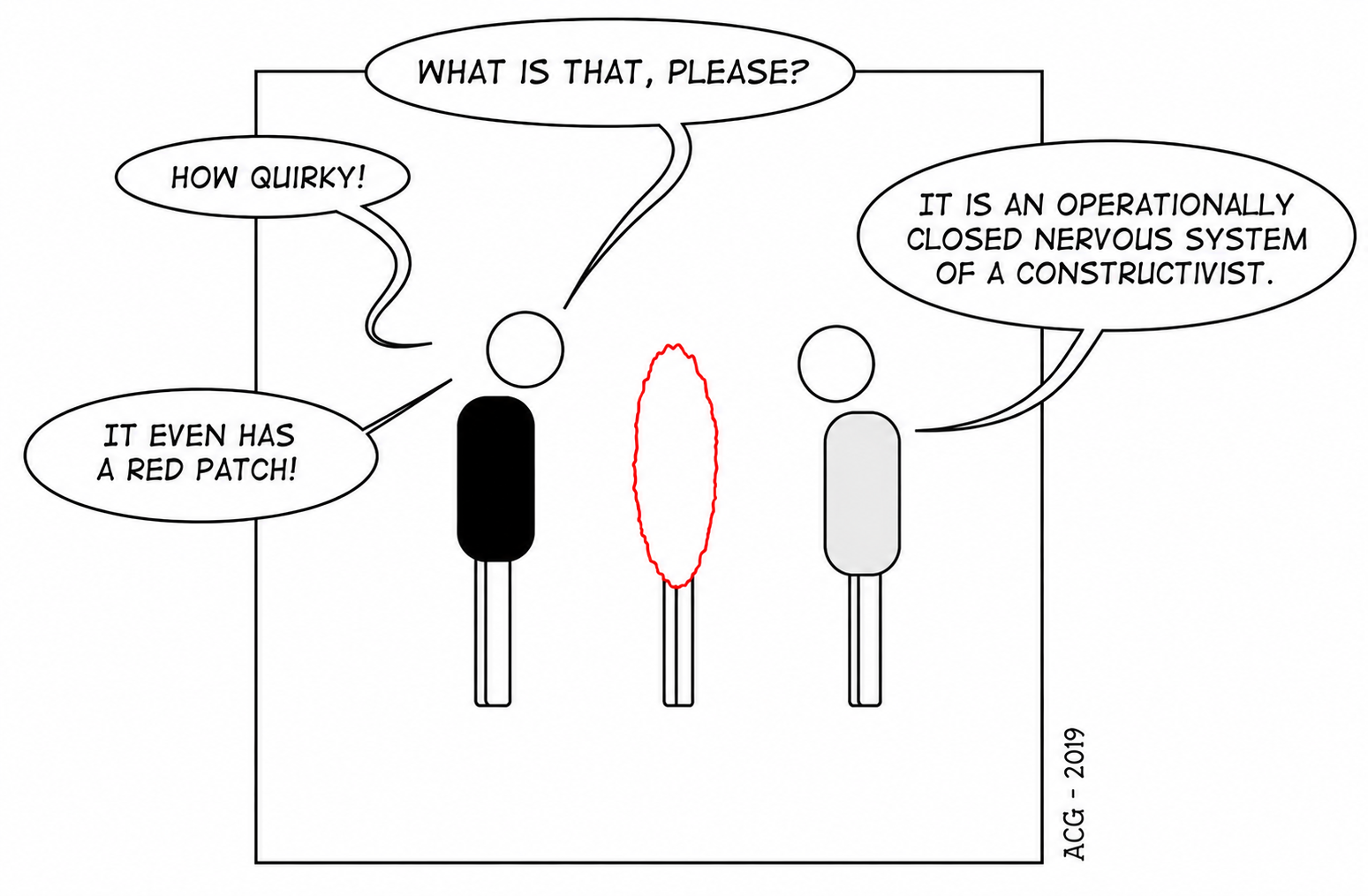
We "see" an operationally closed nervous system, first described by Humberto R. Maturana. Needless to say, one can describe (conceptualize) a nervous system, but the addition of "operationally closed" is not a description of a biological form, but rather a theoretical explanation. One may agree with this theory, but is not required to do so, for example because another approach seems more plausible.
If I consider the human nervous system in isolation, I see a structure that reminds me of a coral. In any case, I do not see anything that appears "operationally closed"; rather, I see nerves branching throughout the entire organism in manifold ways, requiring contacts (for example in the form of motor end plates) in order to fulfill their function. There is nothing here that can be recognized as closed within itself (like a circle).
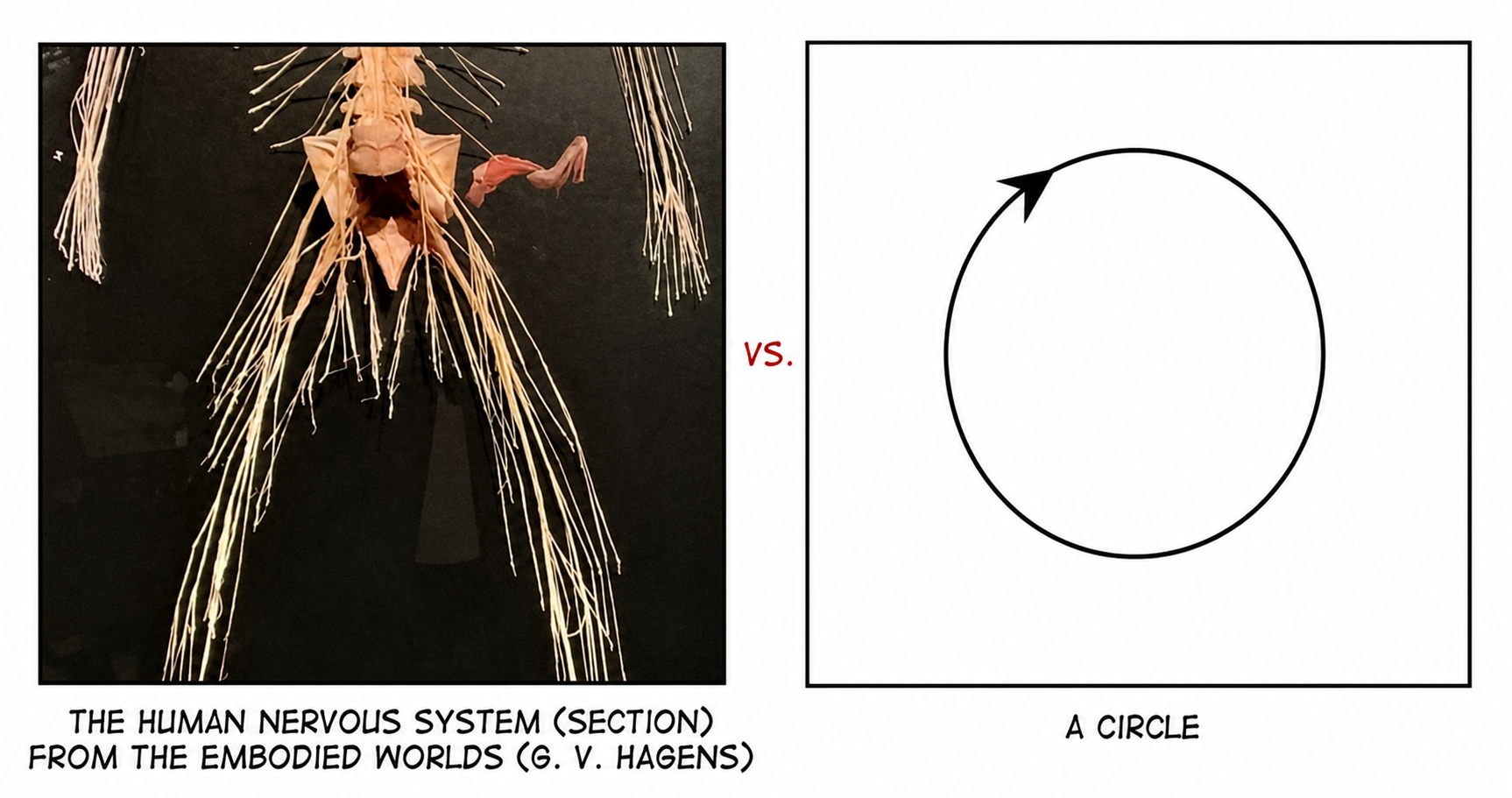
The observation of a "nervous system" is the observation and description of a biological form and has nothing to do with philosophy. Philosophy is concerned, among other things, with exploring the presuppositions underlying statements and then articulating these presuppositions as clearly as possible.
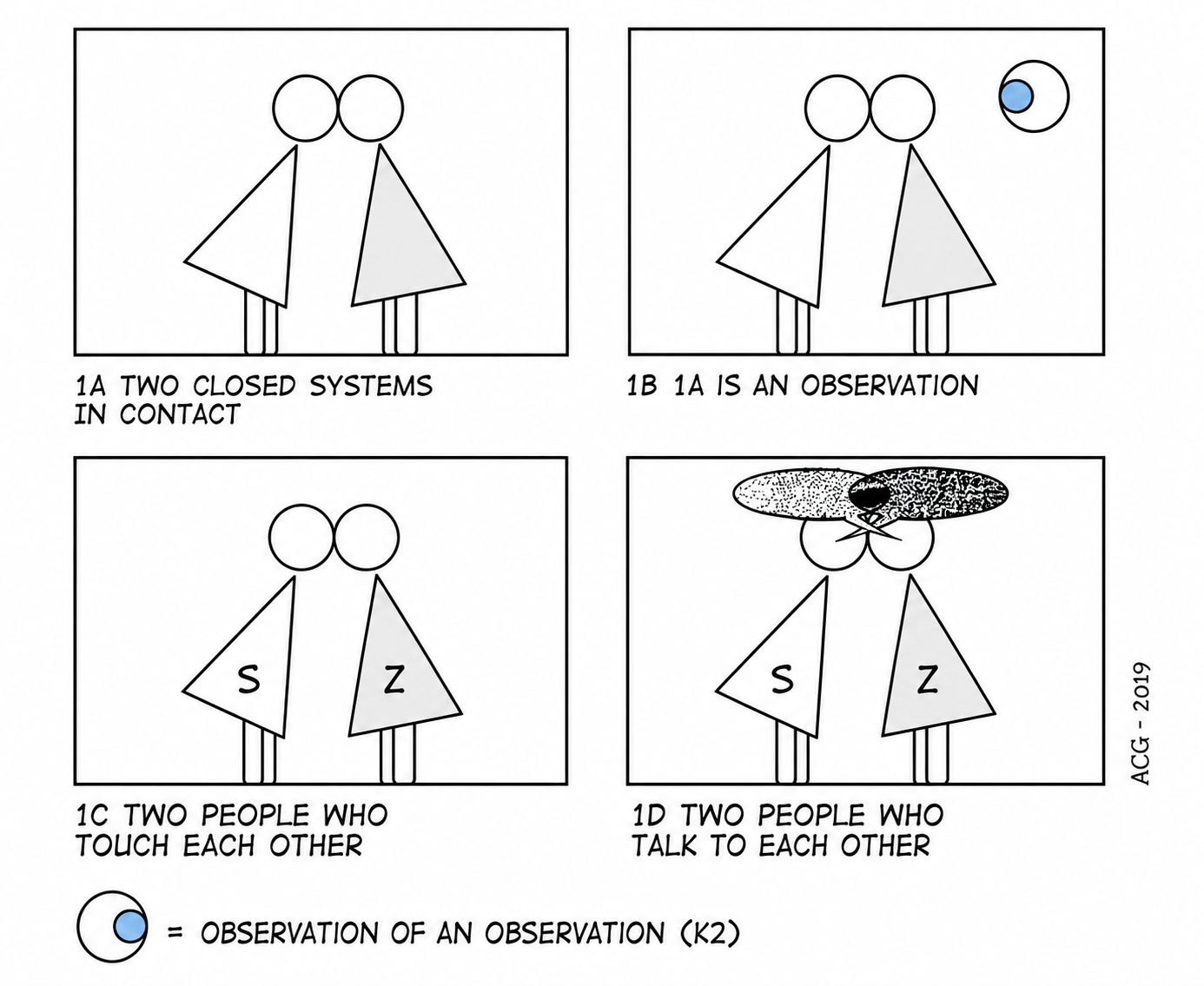
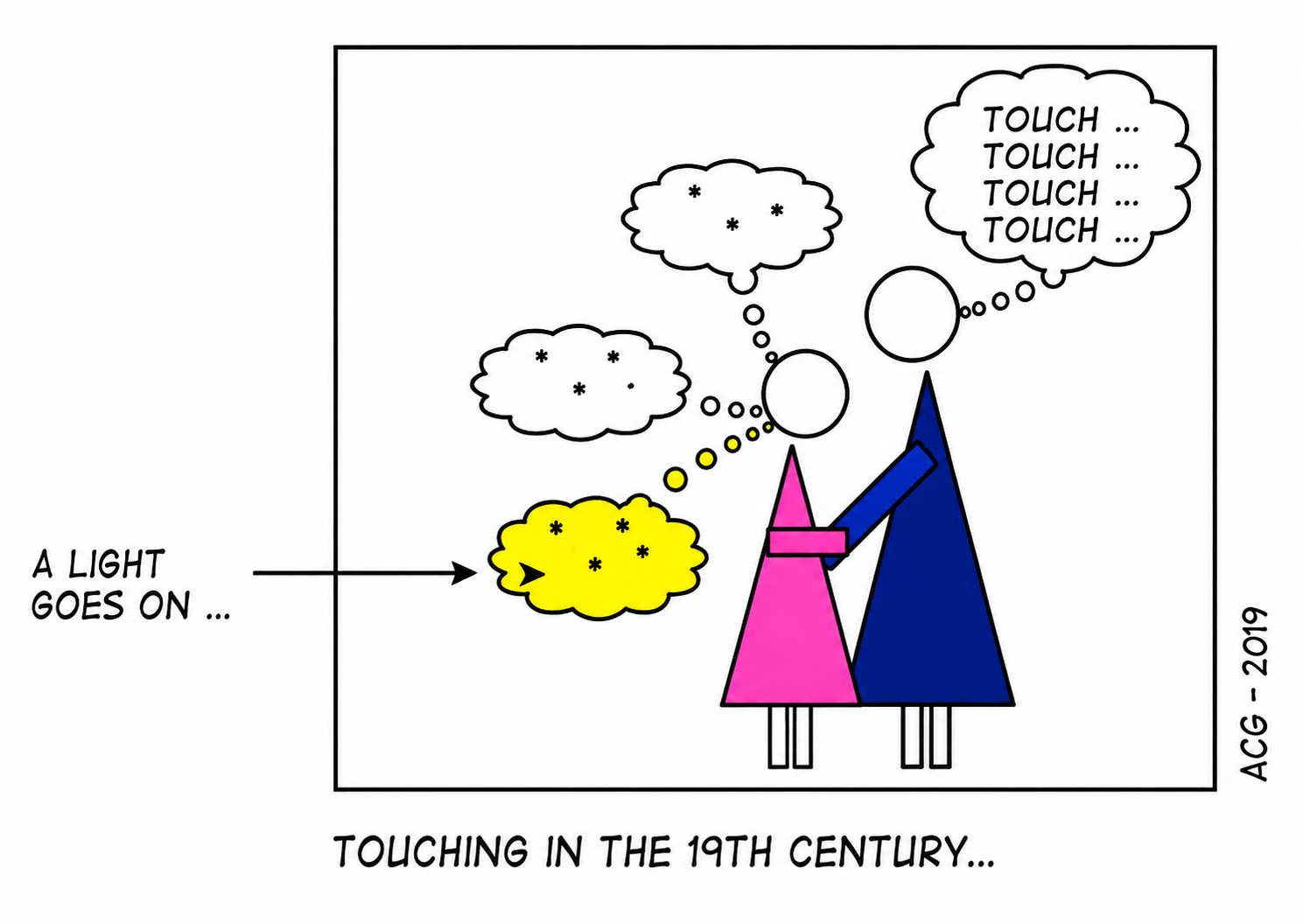
In systemic circles, it is often claimed that one cannot "intervene" in another organism from the outside; a system, it is said, can only be "disturbed" or "irritated" from outside. I illustrated this fundamental assumption in 1A. This statement, in any case, presupposes two systems. However, if I also regard these two systems themselves as already observed (1B), then the primary question is no longer whether and how one "irritates" the other. Rather, the two systems emerge synchronously within the very act of observation; indeed, they can only be observed in this way because there is an observer currently observing them.
For the observer with the sky-blue eyes, the question of the "closedness" and/or "openness" of these two systems is not what stands in the foreground. Rather, this observer wishes to investigate the interaction of the two systems here and now. The "closedness" and/or "openness" of these systems is merely one aspect among many, and presumably it plays no role at all for the two human beings S and Z themselves. In any case, this aspect is of no relevance for the observer with the sky-blue eyes at this particular moment.
Now our observer notices that the two systems touch each other (1C) and subsequently that the two speak with one another (1D). All of this — and much more — can be described in language, and one could even ask the two individuals (S and Z) what they themselves believe they are doing here. That would be very interesting, because it would reflect their own perspective on the situation.
Seen in this way, the "closedness" and/or "openness" of a system is not posited as something absolute, but understood as the observation of an observer. To continually emphasize the "closedness" of a system while observing it appears limiting to me, considering the multitude of aspects we are fundamentally capable of observing. Yet this limitation was not produced by the "system" itself, but by an observer who chooses to view the system in this way — and not otherwise.
On the Self and the Non-Autopoiesis of the Psyche
I have never observed my psyche organizing itself. In fact, I have never even observed a "psyche" at all.
What I can observe within myself are dynamic processes of thinking and feeling unfolding in space and time.
My thinking does not organize itself, nor do my emotions organize themselves; rather, I organize myself. The self organizes this. I think. I feel. And I organize my thinking and feeling. I can guide them. That is something I can observe. But it is not It (the psyche) that governs itself.
And my "I" — it is a creation, indeed my creation, arising here and now, dependent upon context.
A cell can organize itself; multiple cells can organize themselves. But a human being, in my view, is not merely an accumulation of cells. That is the subtle difference. We human beings are capable of directing ourselves; we can also decide what we allow into our interior, what we incorporate into our system. Self-organization is a necessary description for life processes, but autopoiesis is not a sufficient description for human beings who, unlike other animals, are capable of reflecting upon their "I," of stepping outside themselves.
We can interrupt self-organization and, if desired, set it in motion again — for example in the case of suicide. No other animal chooses this form of death. Or, for example, in the case of resuscitation. Rabbits do not possess a defibrillator.
I organize myself through thinking (psychically). It is not It ("the psyche") that organizes me. When It takes control and I lose my self, then — to put it somewhat humorously — I lose the level of reflection upon myself. Clinically, one sometimes speaks in such a case of a person with a "personality disorder." Then the therapeutic task may consist in re-establishing a stable self, in making conscious the observer who observes and acts.
"How does it feel to be an ape?" — what if we were to ask a primate this question?
"Unfortunately, we would never receive an answer.
For as soon as we create with the ape a domain of coexistence that permits such linguistic distinctions through language, the ape will no longer be an ape."
— Humberto R. Maturana and Francisco Varela (1987, p. 241)
Maturana and Varela address the "I" as something that arises through language. They describe a boy (Paul) who, following a commissurotomy, is examined in a particular way in order to selectively "address" either his "left" or his "right" hemisphere (whether this succeeds as precisely as described may remain an open question). In any case, Maturana and Varela conclude as follows:
"All these experiments tell us something fundamental about the way in which that continuous flow of reflections which we call consciousness and associate with our identity is organized and preserves its coherence. On the one hand, they show us that language is a sine qua non condition for the experience of what we call 'mind.' (...) In Paul's case we experience the operational overlap of three different persons in one body. At certain times these persons can be independent, self-conscious beings. This dramatically demonstrates that it is in language that a self, an I, arises — namely as that social singularity which emerges through the operational overlap of recursive linguistic distinctions in which the I is distinguished within the human body. From this we see that within the network of linguistic interactions in which we move, we maintain an ongoing descriptive recursion that we call our 'I.' It allows us to preserve our linguistic operational coherence as well as our adaptation within the domain of language."
— Maturana & Varela (1987, p. 250; translation ACG)
It is interesting that Maturana and Varela do not write about a "psyche" supposedly organizing itself, but rather about an "I." I, too, do not write of a "psyche" organizing itself — and for one reason: I cannot observe this.
What I can observe, however — if I look deeply enough into myself — is my self, which I continuously sustain through acting within language.
On a Shift from Reflecting upon "Consciousness" to Reflecting upon Our Concepts

Here we see two gray rings whose colors are identical, yet which are embedded within different contexts. Depending upon the context, the gray appears differently. The context quite obviously makes a relevant difference. However, the description given by Humberto R. Maturana and Francisco Varela, who interpret this perceptual-psychological example constructivistically in their work The Tree of Knowledge, refers only to the aspect of color, not to the relevance of the "environment", even though it is mentioned:
"The two gray rings are printed in the same color. Nevertheless, the lower ring appears pink in its green surroundings. The color we see is not a property of things; it cannot be separated from the way we as observers are constituted."
— Maturana & Varela (1987, p. 24)
If I focus upon these conceptually grasped aspects (color, context, and so forth), I recognize that I necessarily require concepts in order to consciously recognize anything as anything at all. In this way, I perform a shift from reflecting upon my consciousness to reflecting upon my concepts, upon my language. Conscious experience is bound to language.
Equally remarkable is the fact that Maturana and Varela posit the "context" as something absolute. They speak of a "green environment" as though this "green environment," here and now, were not itself already a construction of an observer currently viewing the image. The moment we look away, the ring disappears (regardless of whichever color it may appear to us), and so too does the context. Yet then we perceive another context — unless we close our eyes, and even then a context remains present in observation, for I still observe myself while closing my eyes. I cannot actively close my eyes while simultaneously pretending that I am not doing so. Observationally, I can never remove myself from my own observation.
The task now is to reconstruct, in a logically coherent manner, how this feat of "world-construction" concretely becomes possible for us.
Body and Mind - Two Conceptually Conceived Aspects
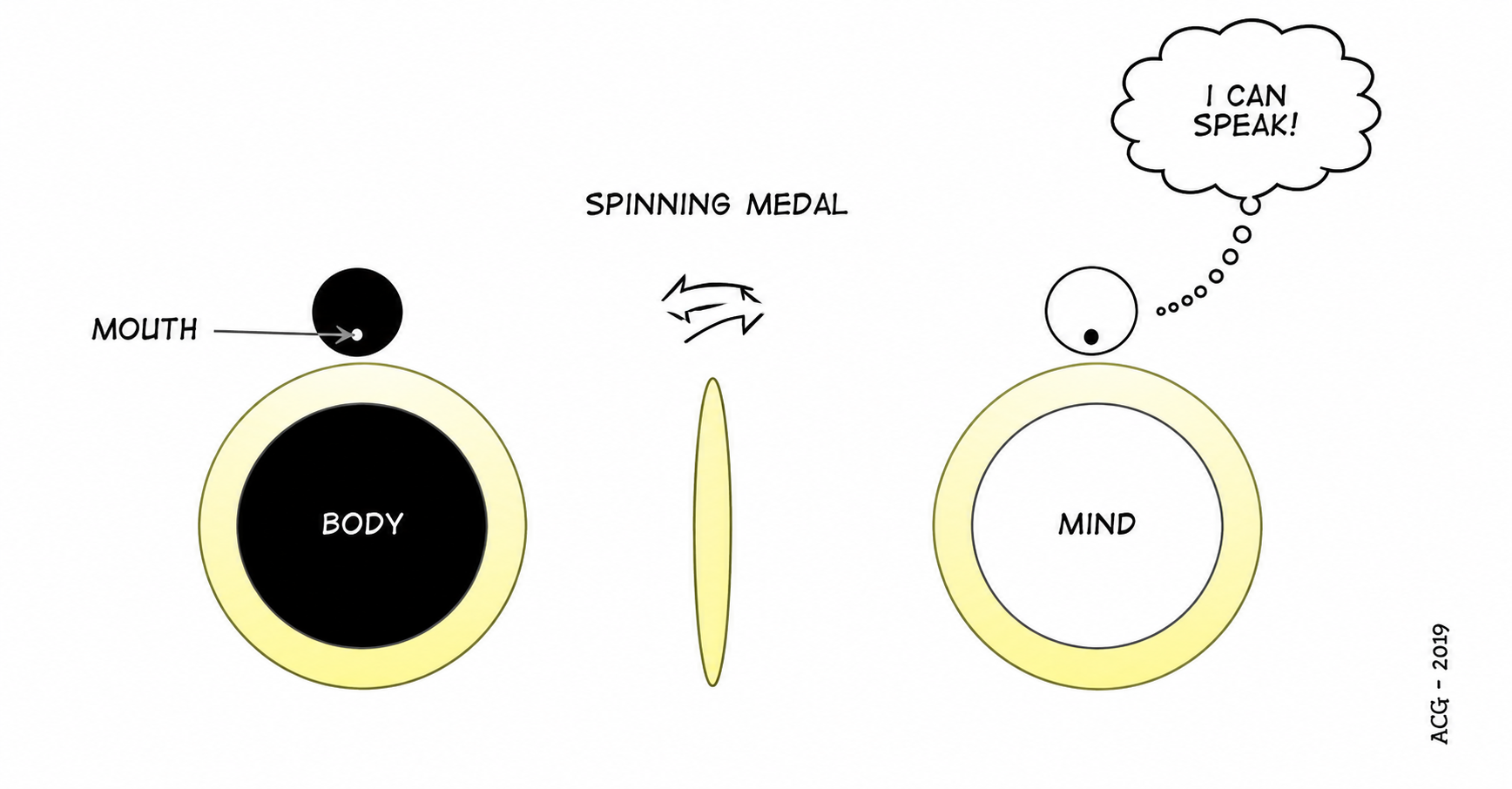
When I speak of an organism, I speak of a psychophysical unity in which attention may be directed toward bodily and/or mental aspects. This duality can be meaningful. And yet, they are always two sides of the same coin. They form a non-duality. To attend to something means to direct one's attention conceptually.
Concepts are embodied concepts.
Since concepts are embodied, they cannot be separated from the body. I find this immediately evident. Conversely, a body is understood conceptually as a "body" the moment we speak of a "body." This way of thinking dissolves the duality between a "body" and its "mind," understanding this duality as quite useful, though only conventionally real (and not absolutely real).
The separation between a "body" and its "mind" arose from our thinking.
And to think something means to use concepts in a rule-governed (and therefore repeatable) manner, such that we ultimately conclude: "I have just thought something."
Observers and Their Conceptual Grasping

Sound requires the entire organism here and now in order to shape it precisely in this way and not otherwise. Meaning always arises only here and now. And never otherwise.
When I speak of descriptions, I mean conceptually grasped concepts in the here and now. I mean those waves that are articulated in an embodied manner here and now, within a particular situation. These concepts can be used to describe something in the world. And yet we do not describe something that would already exist as conceptually grasped in itself beyond our embodied concepts; rather, we conceptually grasp it here and now as this particular something.
In this work I conceptually reconstruct my own conceptual grasping. My concern is with reconstructive descriptions, not explanations. I am not developing theories here; rather, I attempt to conceptually grasp my conceptual grasping through language (limited as I am linguistically).
Whenever we explain something, we construct theories hypothetically, whereas I reconstruct a process descriptively here and now — without any claim to completeness.
When we use concepts, we always fall back, almost immediately after grasping something, upon conceptual structures we have already learned. We have learned rules for how to articulate something, how to move through a room, how to sit down at a table, how to bring a fork to the mouth, how to manage our everyday lives surrounded by strange objects.
On Communication

What we call thinking or cognition arises through processes of communication. It also disappears through processes of communication — namely whenever thinking or cognition is denied to someone or something.
Thus dogs, cats, fish, or tadpoles (and so forth) can also think — each in their own way. One could then speak of dog-thinking — perhaps even distinguishing here between pug-thinking and dachshund-thinking — cat-thinking, fish-thinking, tadpole-thinking, and so on.
We observe coordinated behavior that we interpret as communication. Or, to quote Simon:
"The method of coordinating the behavior of organisms is communication."
(Proposition 21.3.1, Simon 2018, p. 58)
Arbitrary Punctuation?
The first time I heard the song "Malibu" by Miley Cyrus on the radio, I understood "my elbow" instead of "Malibu" and asked my children why Miley would be singing about her elbow. They looked at me in confusion and then explained: "Malibu, Mom — don't you get it?"
What is happening here?
Who does not know children (and sometimes adults as well) who do not actually know the lyrics of a song and simply sing along with whatever they think they hear? They invent words that sound somewhat similar to the heard sounds.
And yet, if we make a certain effort, we can punctuate a stream of sounds in a sufficiently similar way — namely once we have learned the words. Therein lies the whole joke of understanding.
We must know the rules and the concepts — or better still, the written words themselves (just to be certain) — which is, after all, what one generally does when learning to use a language and being allowed to attend school.
Even then, of course, one may mentally emphasize certain words more than others, but ordinarily a word is emphasized either by pronouncing it with particular stress or, as I do here, by highlighting it in bold.
This form of punctuation can likewise be followed by others, if they feel inclined to do so. After all, they are not required to follow these rules, even though we usually do.
Absurdly enough, not following rules still includes those rules. Refusing to obey something is itself also a — albeit paradoxical — form of obedience, because one must make the effort to do precisely what one is actually not supposed to do.
That can become terribly exhausting.
Strictly speaking, however, we do not punctuate a stream of sounds, because when speaking we do not place signs (or words) into the world (interpunctio in Latin means punctuation or the placing of signs). Rather, we insert pauses while speaking.
Once we have learned word-images, it becomes almost impossible to imagine a language without word-images.
And yet this is precisely how children speak before they learn to read and thereby learn to produce words or word-images.
We tend to forget our own development.
The development from speaking and embodied understanding to reading and writing.
And by overlooking this development, we may perhaps become philosophers in order to remember this process again — and through writing and reading prevent the forgetting of our own development
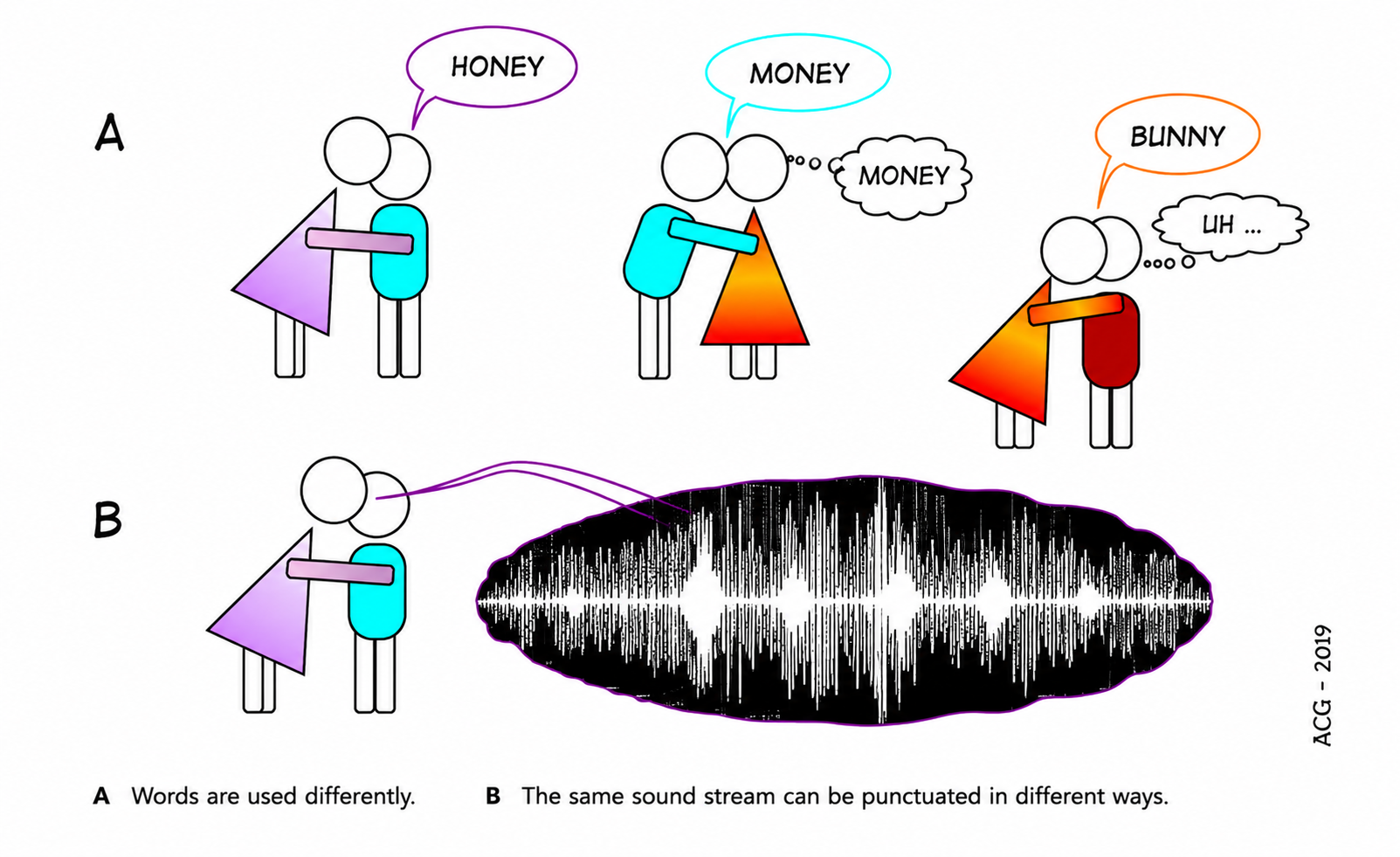
Of course, no words (no signs) are transported through the air when we speak, as I drew it under A merely so that you would also have something to read here. Rather, speaking produces nothing but changes in air pressure (B). Thus no information (nothing inherently encoded) is sent from the girl to the boy through speaking. We must imagine speaking in a completely different way!
We all know the children's game "Chinese Whispers." One child whispers a word into another child's ear, that child whispers what it understood into the next child's ear, and at the end the first and the last child compare the words. Usually to everyone's amusement.
But not always. It can also happen that a word comes out at the "end" exactly as it was "input" at the beginning of the line of children. To prevent this from happening, children who already understand the joke of the game are usually clever enough not to use the simplest words (like kissy, Susie, or pee-pee), but rather more complex ones (such as earflap, urine-scale remover, or menstrual cup).
Experience shows that more complex terms are misunderstood more easily than less complex ones. Why might that be? I think it is an interesting question.
In my opinion, we can only understand something for which we have already established a concept. If, as a child, I have never heard the term "urine-scale remover" before, then I may understand almost anything — just not "urine-scale remover."
And if I do not understand parts of it because they were spoken too quietly or mumbled, then I also cannot meaningfully complete the missing remainder. I will therefore "piece together" some term of my own invention and pass that along in turn.
What enters the ears as a sound wave is therefore by no means arbitrary, but it also contains no "information" in the sense of something encoded.
Information only arises at the moment of direct contact between the transmitted vibration/movement and the hair cells of the cochlea (I am speaking here of human beings) and the resulting "stimulus pattern" — that is, only in contact with a listener (who through this contact becomes a listener in the first place).
But even this "stimulus pattern" is not yet "information" in the sense of "a difference that makes a difference" (Bateson 1997, p. 274), because it must also be grasped as a "stimulus pattern," interpreted conceptually by the child accordingly. Otherwise it is nothing more than a neutral pattern (just as the neural code is neutral; cf. Roth 1997, p. 93), free of meaning.

If someone is already capable of uttering something that both they themselves and the people who may be listening subsequently perceive as "meaningful," then this requires an enormous number of preconditions.
In the first image we see two people, presumably female, facing one another. To make this easier to recognize, I have gifted each of them a nose. The two women stand fully within life. They are connected to the ground, they are situated within a space that they have already conceptualized, and we may assume here that the two know one another.
A knows that B can speak and masters the German language. B knows the same about A.
But that is not all.
While speaking, A and B observe one another; they form impressions of each other, study one another reciprocally, and create a context — indeed, they have been doing so the entire time while I am still writing this.
Let us imagine (1B) that B has something on her head that A has never before seen on B. We may safely assume that the conversation will begin with this. This strange something would have an irritating effect upon A; it would not fit her image of B.
Thus, even before the two begin speaking, they have already created a context — that is, they have conceptually drawn certain distinctions while neglecting others.
Even before they begin speaking, A reaches toward her head, and B does the same (1C). In this way they jointly direct their attention toward the head — both their own and that of the other. Both point toward something.
And only now does the first spoken sound sequence finally occur (1D).
This sound is spoken by A and enters both her own ears and the ears of B. It is a sound that "hangs" in the room for a moment; anyone located within that room could hear it. One does not even need to look in order to hear it.
And yet looking facilitates understanding, because while listening we also study the bodily posture of the speaker and draw conclusions from it regarding what the other person may currently be uttering.
Let us say that A now says, "Ouch."
At no point can we visually perceive this "ouch." Rather, it has been understood as such (by me), and I now write it down here for you.
All that A actually produced were sounds that propagated through the air and led to a specific stimulation of the basilar membrane within the inner ear of B (and A). This stimulus pattern was transmitted via the auditory nerve and various relay nuclei to the cerebral cortex.
Now A, already having mastered the technique of the German language, has learned which embodied movements are coupled with which sounds, and she learned this through the feedback loop between speaking and hearing. After all, a child only learns to speak if it is able to hear itself while speaking.
In learning to speak, specific stimulus patterns became coupled with specific bodily movements. Thus, once a language is mastered, these specific stimulus patterns can also be interpreted by B — and here this means: enriched with meaning in an embodied way.
The meaning, however, is not contained within the stimulus pattern transported via the auditory nerve to the brain. Rather, the enrichment with meaning occurs in an embodied manner out of everything that B has already learned on the one hand and everything that B is currently perceiving (that is, conceptualizing) with all the other senses as well — context-dependently — on the other.
No information in the sense of "a difference that makes a difference" (Bateson 1997, p. 274) was contained in the changes in air pressure that briefly propagated through the room. This information was, and is, generated in an embodied way.
On the Impossibility of a Private Language
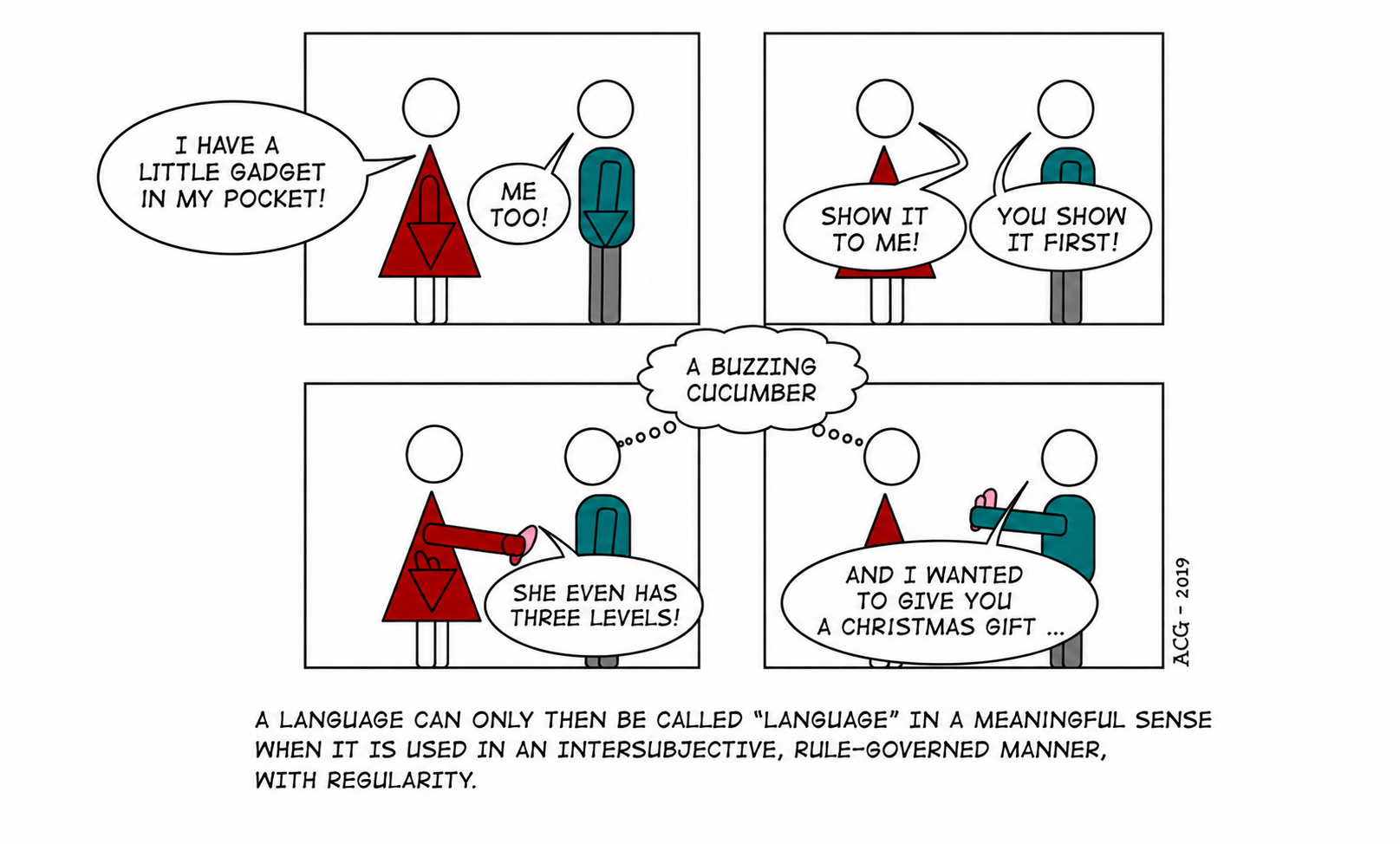
Ludwig Wittgenstein once presented, long ago, compelling arguments against the idea of a "private language."
At the core of his Philosophical Investigations lies the famous "beetle analogy" (§293), through which he argues that a concept such as the concept "beetle" acquires its meaning only within an intersubjective language game — that is, within a shared practice in which the term has a meaning here and now in relation to something.
One could also say:
The expression "beetle" and a "beetle" arise dependently together here and now.
And intersubjective language games moreover presuppose rules that guide the use of concepts.
These arguments, however, do not yet seem to have reached all philosophers.
What follows, therefore, is an attempt to bring his line of argument into the present day — also in order to show that word meanings are by no means "subjective", as some radical constructivists occasionally claim.
On Percepts and Concepts
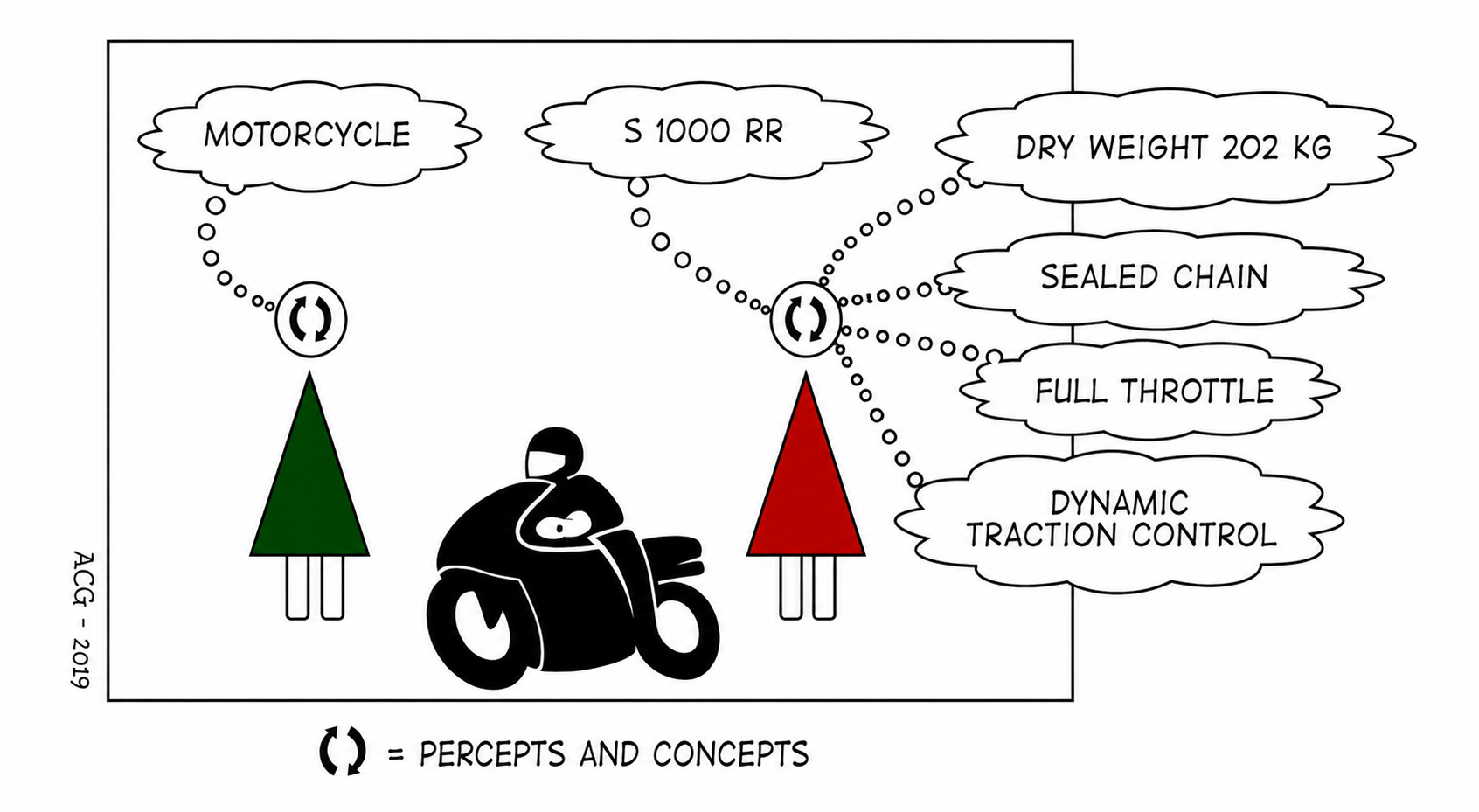
A percept may be understood as a stimulus that touches the senses.
A concept, by contrast, may be understood as an embodied and repeatable pattern of movement and touch.
This process of recognizing something as something takes place as a mental operation within the embodied observer.
Without concepts, we possess no knowledge at all — of anything.
For this reason, it also makes sense to spend years studying medicine, biology, chemistry, psychology, philosophy, sociology, geology, history, Tibetology, musicology, film studies, or whatever else, in order to build up a conceptual vocabulary and thereby automatically come to live within conceptually rich realities.
Otherwise, "everything" may perhaps remain merely "something" — or simply "that thing there."
On the Intertwining of Percepts and Concepts
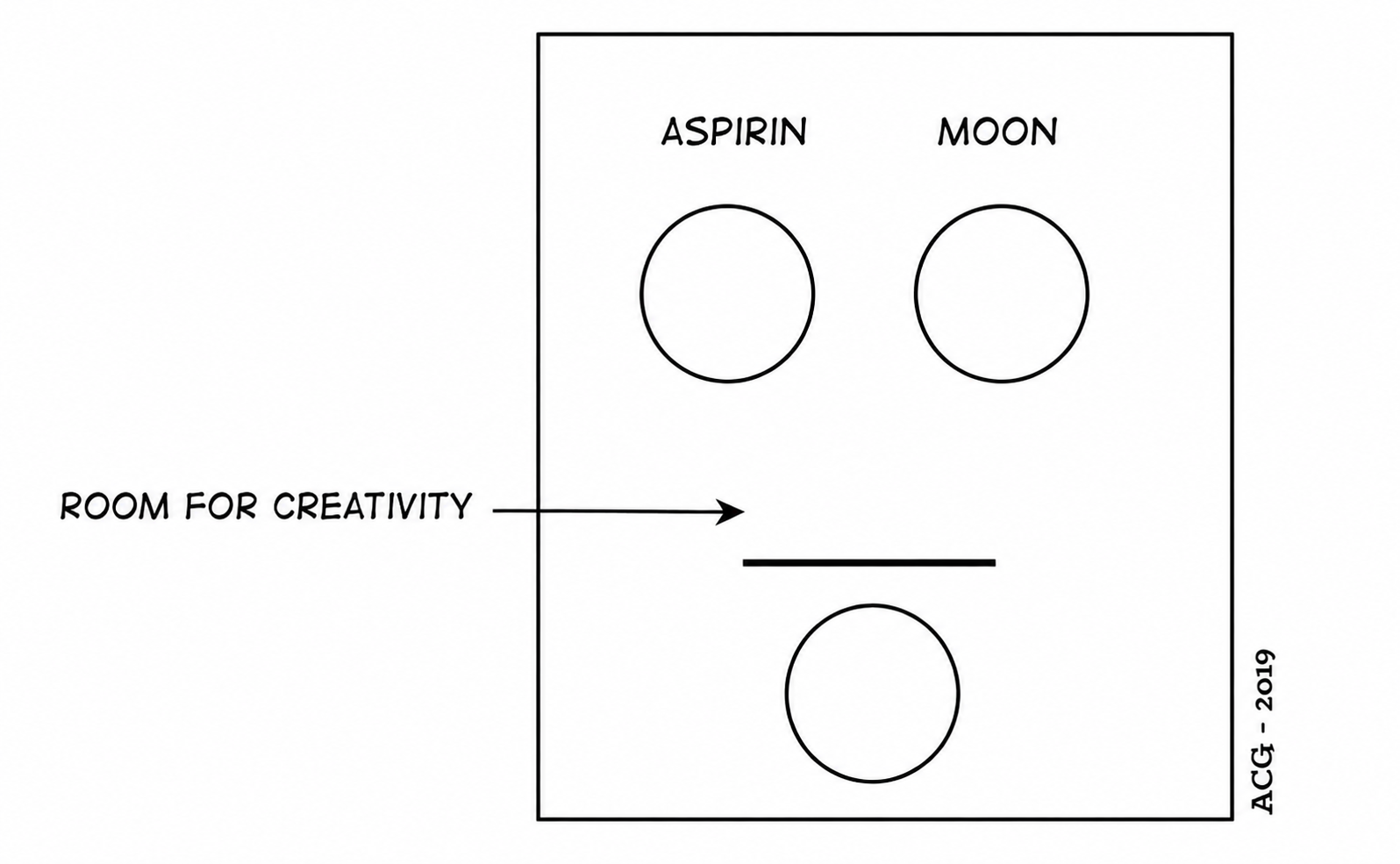
Our percepts and our concepts are intimately intertwined in the here and now; otherwise we could perceive nothing meaningful, never see, hear, smell, taste, or feel anything as something definite.
How dull our existence would be.
What magical enchantment dwells within our embodied concepts.
They are in-worlded.
Only once we have grasped something as something can we — through further processes of development and learning — also designate it in writing.
But we must in turn grasp these designations as well; that is, while reading we must transform them into grasped concepts (inner patterns of movement and touch = sensorimotor patterns), just as you, my esteemed readers, are doing right now, in order to enrich these written words here with meaning.
These designations appear to be attached "onto" something in order to distinguish this "something" from "something else" — although this "something" had already long since been grasped (conceptualized) beforehand.
Some people forget or overlook these continuously occurring processes of conceptualization that underlie written designations, presumably because they are so self-evident.
And why should we reflect upon what is self-evident?
So then:
Let us simply take reading for granted.
Let us stop philosophizing once we arrive at words, signs, and sentences.
The return of the eternally same.
Or perhaps not?
On Processing Speed
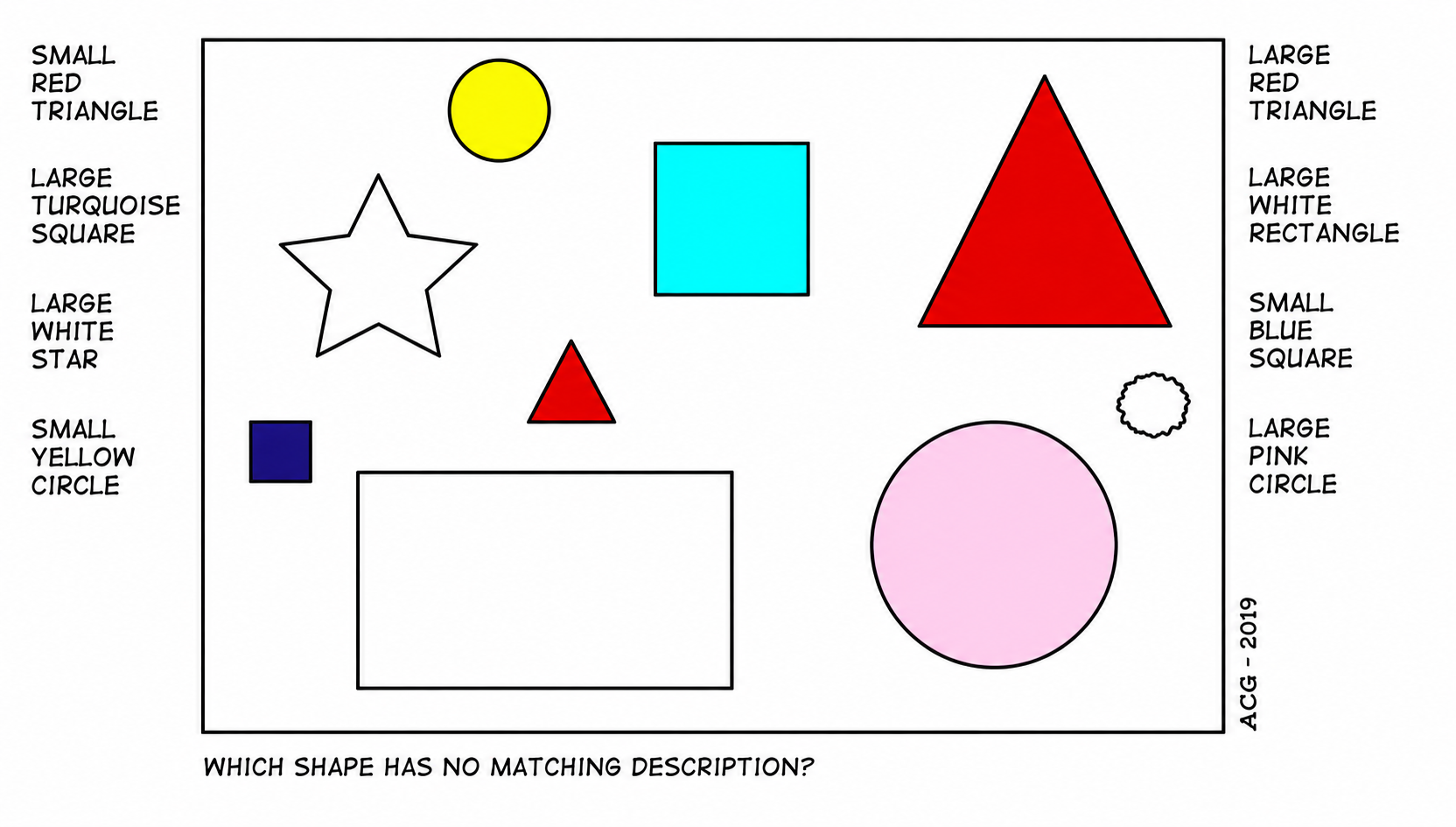
Psychologists speak of "processing speed" when referring to the "mental process," although naturally only the output of the "black box" can be measured — not the internal speed at which thoughts race.
And they do race, at least when I observe myself.
A most astonishing achievement of an organism. Within the millisecond of perceiving a "shape," the "shape" becomes a "shape." I can perceive only that for which I have already learned a concept.
The process of perception does not proceed from a "pink circle" to the realization that there is a "pink circle." Rather, it proceeds from the learned concept of what a "pink circle" looks like toward the realization that there is a "pink circle."
And if it is not a "pink circle," then it is still "something." Something is always already distinguished as "something" (conceptually grasped). Children ask: "What is that?" The concept "something" or "that" is so simple that we rarely reflect upon it. And yet it is one of the simplest forms of categorization.
Concepts as Patterns of Movement and Touch
Stories such as that of Helen Keller (1880–1968), who became completely blind and deaf at the age of nineteen months as the result of an illness, vividly place sensorimotor concepts "before our eyes."
According to her recollections (that is, reconstructions), which should not be regarded uncritically, Helen was able during early childhood to make herself understood through simple gestures — for example, shaking her head for "no," nodding for "yes," pulling someone toward her for "come," or pushing someone away for "go."
The decisive turn toward conceptual understanding occurred on March 3, 1887, three months before Helen Keller's seventh birthday. On that day, lessons with her teacher Anne Sullivan began.
Helen Keller recalls the experience in her memoirs as follows:
"The morning after my teacher came she led me into her room and gave me a doll. (…) After I had played with it a little while, Miss Sullivan slowly spelled into my hand the word d-o-l-l. This finger play fascinated me at once and I tried to imitate it. When I finally succeeded in making the letters correctly, I flushed with childish pleasure and pride. I ran downstairs to my mother, held up my hand, and made the letters I had just learned. At that time I did not know that I was spelling a word or even that words existed; I was simply making my fingers move in monkey-like imitation. During the following days I learned to spell in this uncomprehending way a great many words, among them pin, hat, cup, and a few verbs such as sit, stand, and walk. But my teacher had been with me several weeks before I understood that everything has a name. (…) Miss Sullivan had tried to impress upon me that m-u-g is mug and that w-a-t-e-r is water, but I persisted in confusing the two. In despair she dropped the subject for the time being, only to renew it at the first opportunity." (The Story of My Life, 1907, pp. 22–23)
As one can see from this written recollection of Helen Keller, the meaning Helen associated with the touches was obviously different from the meaning Anne Sullivan was trying to convey to her. Only the interplay between a sensation and a repeatedly sensorimotorically grasped concept within the concrete here and now enabled Helen to understand the meaning of a concept. At the same time, "not understanding" and "understanding" seem to reveal themselves immediately, even though they cannot truly be verified objectively. After all, we cannot look into another person and objectify their understanding or misunderstanding. Yet it manifests directly in behavior, and Helen Keller herself describes it vividly as "monkey-like imitation" or as a "mindless way" of repeating movements.
We can say that we "understand" or "do not understand" something. Since Helen Keller only became ill at the age of nineteen months, and before that had already experienced the world as a seeing and hearing child — according to her later reconstruction she had even spoken individual words such as "tea" — learning the "Morse-like signs" at around the age of seven seems to have awakened a vague memory of something once learned or once used. Certainly, even the memory of this memory must itself be regarded as vague and likely reshaped by later learning experiences. After all, at that earlier point she could not yet have known anything about a honeysuckle vine.
We walked down the path to the well-house, attracted by the fragrance of the honeysuckle with which it was covered. Someone was drawing water, and my teacher placed my hand under the spout. As the cool stream flowed over one hand, she spelled into the other the word water, first slowly, then rapidly. I stood still, my whole attention fixed upon the motions of her fingers. Suddenly I felt a misty consciousness as of something forgotten — a thrill of returning thought — and somehow the mystery of language was revealed to me. I knew then that water meant that wonderful cool something flowing over my hand.
— Helen Keller, The Story of My Life (1907)
Here, one can empirically observe what I previously attempted to reconstruct logically — namely, that a concept emerges through repeated patterns of movement and touch. The feeling of something, together with the simultaneously repeated embodied grasping of a concept, led Helen to understand the meaning of water here and now.
Before that moment, Helen Keller did not know that there was such a thing as water, even though she had already learned an empty conceptual shell ("water") whose meaning remained obscure to her. Meaning only emerged through, on the one hand, a sensation (percepts), and on the other hand, a repeated experiential pattern (concepts) associated with that sensation, within the concrete here and now.
In this sense, concepts are not detached abstractions hovering independently of lived experience. Rather, they are embodied patterns of coordinated sensing, movement, and repetition. Helen Keller did not discover the meaning of "water" by decoding a hidden symbol. Meaning arose in the lived coupling of touch, movement, memory, and situation.
On Relativity
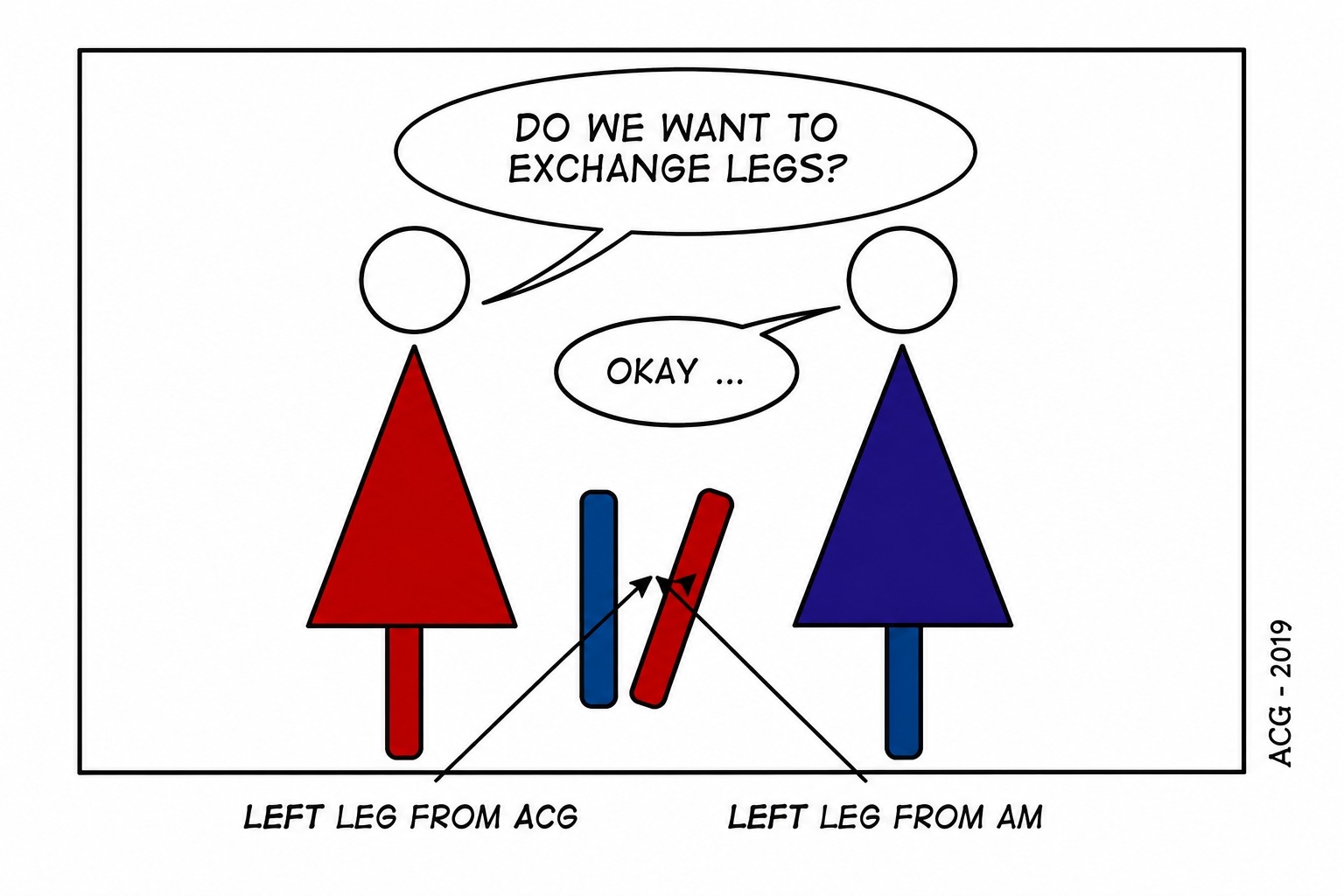
Names cannot simply be exchanged at will, because when we exchange names, we also exchange the objects or states of affairs that "cooperate" with them in the here and now. This can lead to considerable confusion. Names do not merely function as labels used to designate something in the world (although they do that as well); rather, names are what allow us to conceptually grasp something as something in the first place.
If we arbitrarily exchange names and thereby violate intersubjective rules of the game, we may point this out during the game so that the others can orient themselves again. But if we exchange names arbitrarily in a clinical context — for example, confusing a patient's left foot with the right foot, medication A with medication B, or the findings of patient A with those of patient B — we invite catastrophe.
We have not defined left and right arbitrarily (within a given context). Medications are not named randomly, and the written medical findings of one patient apply only to that patient in the here and now, not to someone else. All of this may appear banal, and yet we know that mix-ups do occur: the wrong foot may be operated on, the wrong medication administered, or findings may not be checked for their fit to the respective person.
If we did not attach labels to persons and objects — literal name tags in the strict sense — nothing would indicate who or what that person or object is supposed to be. Of course, we can form our own concepts (after all, one can usually also speak with persons) and thereby arrive at our own perspective. Concepts become objective insofar as they are publicly and intersubjectively readable — for everyone who can read — when they are written onto persons or objects.
"Objective" here does not mean that the labels are supplied by the objects themselves. Rather, it means that they arise from an intersubjectively negotiated conceptual consensus concerning an object in the here and now.
Observers can behave according to rules and thereby use concepts in standardized ways.
A nurse, for example, will not interpret a marking on a patient's left foot as the meaningless scribbling of a three-year-old child, but rather as a mark intended for the surgeon. Likewise, one does not look at the writing on a medication package as though the letters could mentally be rearranged into a new order. Instead, one reads as one has learned to read in a particular culture: for example, by moving one's eyes from left to right across a line and transforming letter after letter into (silent) sound sequences.
Of course, one could also spell aloud the writing on infusion bottles in a hospital. Yet one may wonder how long someone would continue to work successfully as a physician (or in a similar profession) if they did so routinely. We implicitly follow such an overwhelming abundance of rules that a complete account of them would be impossible.
In the Light of Mahāyāna Buddhism
His Holiness the 14th Dalai Lama discusses the following crucial point in a conversation with Francisco Varela and Jeremy Hayward. Yet neither of the two follows up on it — the point simply fades away within the conversation:
"…when we examine a phenomenon, this pen for example, we first ask whether it exists from its own side, that is, independently of whether it is perceived or not. In doing so, we discover that the pen does not exist from its own side. If you investigate the pen, you examine its shape and color, you take it apart and inspect its individual components — but nowhere do you encounter something that is, in the ultimate sense, the pen itself. Thus you arrive at the conclusion that there is no pen in and of itself, yet you also cannot simply say that there is no pen … on the one hand, you cannot say that the pen does not exist, but on the other hand, after examining it, you have found no pen in itself. So how does it exist? It exists through the power of conceptual designation. It is not that you particularly like this idea, but what alternative remains?"
(Hayward & Varela 1998, pp. 69–70; emphasis by the author)
Much of what has been explained here, in my view, already exists within Buddhist philosophy, especially within the philosophy of the Middle Way. There it is said that appearances are empty — they do not exist from their own side, but only on a conventional basis.
Why Varela, who worked closely with the Dalai Lama, excluded biological form (the nervous system, the body, the cell, and so forth) from this self-referential reflection is not entirely clear. It is precisely this reflexive and observing loop — concerning myself as observer — that I am attempting to carry out conceptually here.
On Dependent Arising

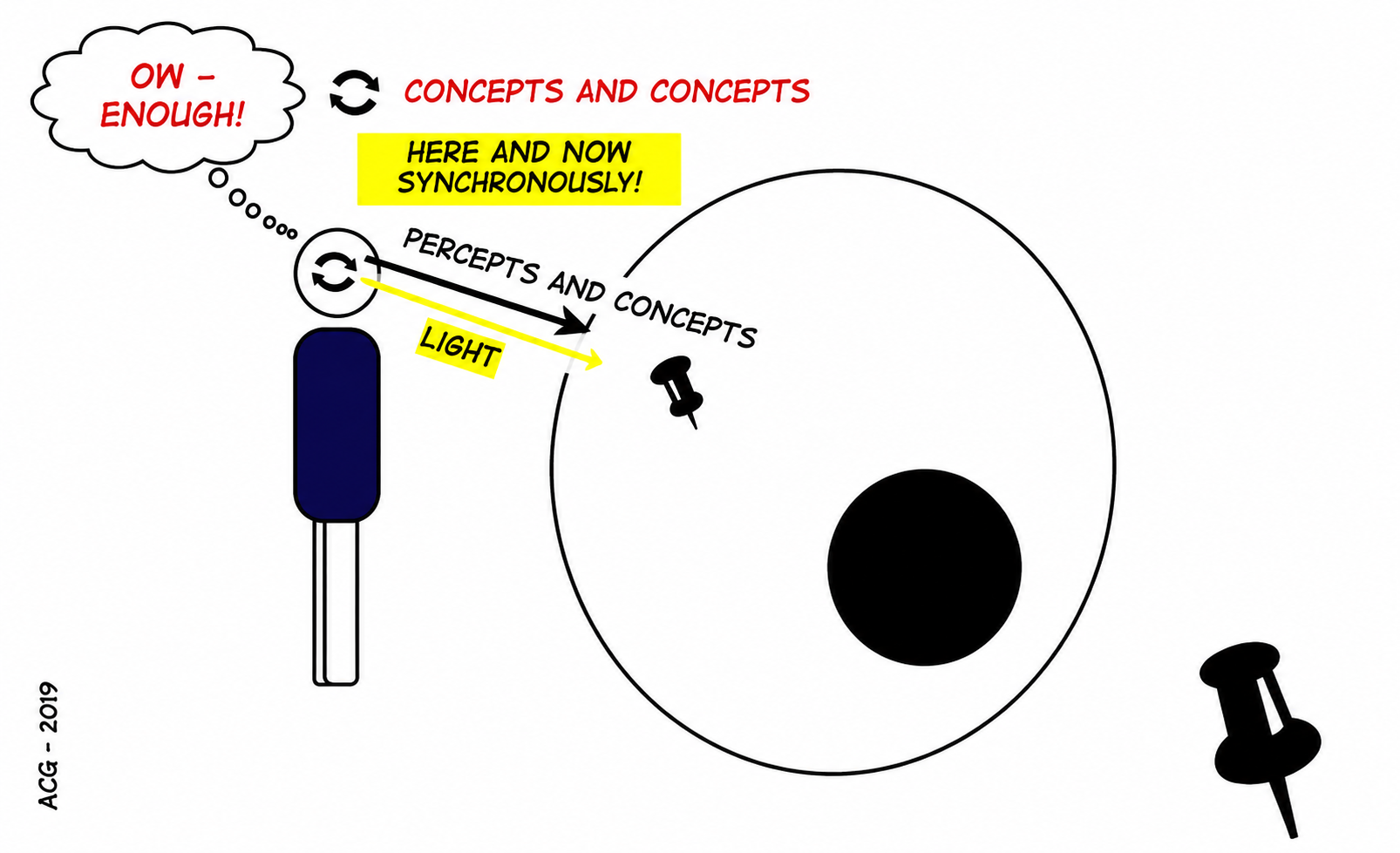
Everything that is, is here and now. The sphere is here and now a sphere because it is depicted here and now and because I can regard it here as a sphere. To see something as a sphere also means, in this context, to read that it is a sphere and not an egg. Not a ball. Not a tear. Nor a planet. Not a sun. Not a cell. Not a pearl. Nor a candy.
What something is, or is not, depends on the conceptual structure present here and now into which it is embedded and toward which I direct my attention.
The conceived concept and the form conceptually grasped in the here and now are therefore to be thought of as a unity.
This perspective of the dependent arising of concept and the conceptualized object can frequently be found in Buddhist philosophy, especially in Mahāyāna Buddhism. Since in this work I am pursuing a reconstructive, analytical path, and by no means a religious one, I do not wish to elaborate further on Buddhist philosophy. However, I also do not wish to conceal that the idea of the dependent arising of concept and conceptualized object has long been the subject of philosophical reflection.
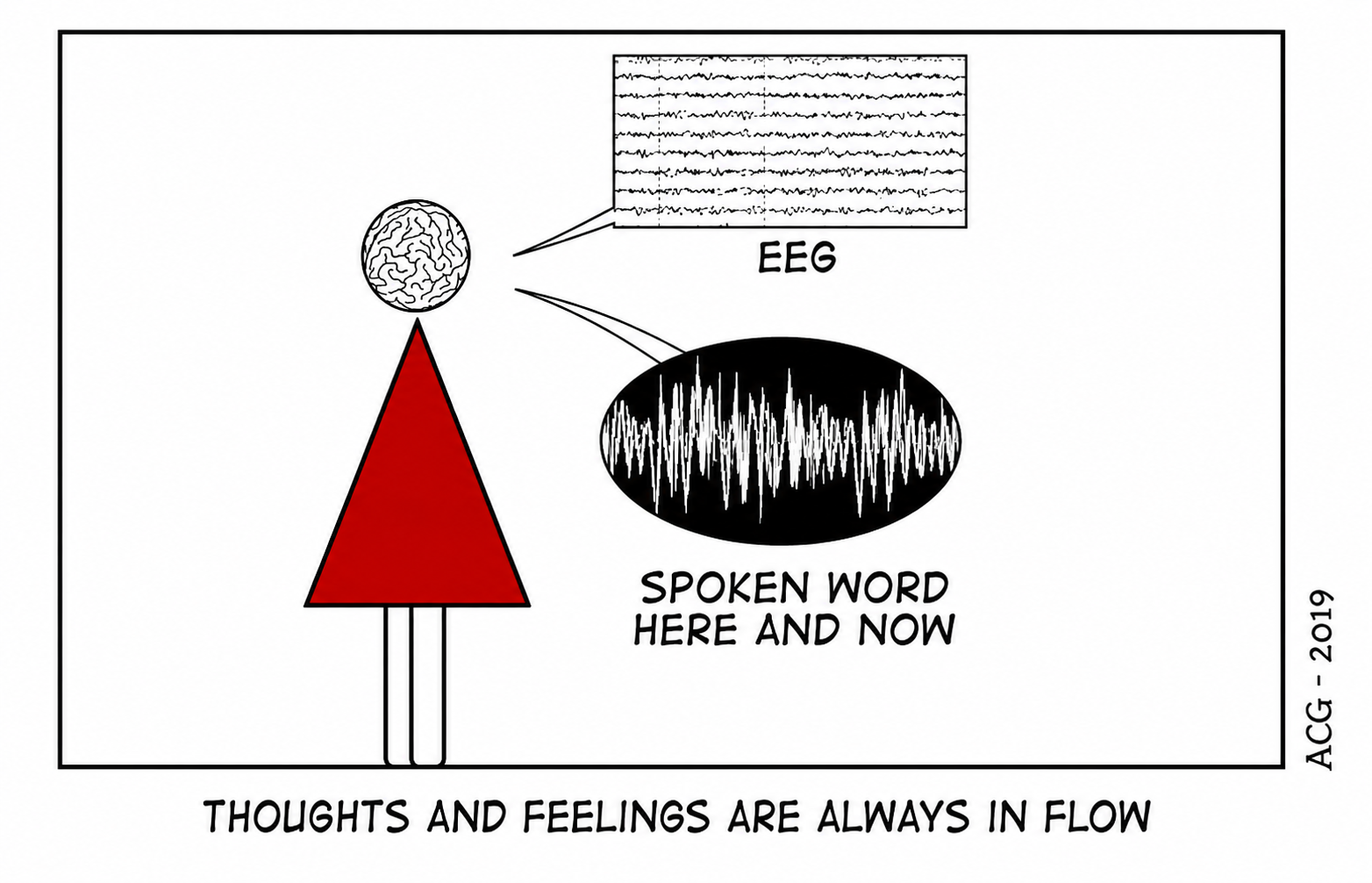
Our concepts and that which is conceptually grasped arise in dependence, almost the very moment we comprehend something as something. Subsequently, we do not merely comprehend something as x, but conceptually as an arm, leg, brain, nose, ear, human being, dog, rat, cell, finger, hand (…) and so forth. Let us think of the concept and that which is conceptually grasped as co-arising (again a concept from Buddhist philosophy) in the here and now.
It becomes more difficult when we speak of "things" that are not actually "things," for example feelings and thoughts, and perhaps even feelings and thoughts that lead to behavior deviating from the so-called "norm." Here there is nothing tangible, because these concepts cannot themselves be grasped. They are umbrella terms for a wide variety of behaviors, sensations, and emotional states of an organism. Feelings and thoughts cannot be grasped in the haptic sense.
If we can accept this, then we can calmly observe our thoughts and feelings as they come and go. At no point can we isolate and "find" these feelings and thoughts within biological structures. Rather, our biological structures enable a broad variety of behavioral patterns, which are then named by observers (who are always personally involved as observers) as feelings or thoughts.
From the perspective of second-order cybernetics, which continually seeks to observe observations themselves, we can describe how an organism generates behavioral patterns within a specific context; that is, we can describe the conditions that are necessary (or not necessary) for certain behavioral patterns.
For example, I will not easily be able to dance ballet if I have not sufficiently trained my muscles, if I do not have adequate control over my body and its positions in space. Having this body "under control" is a continuously ongoing feedback process, because the "body" as "body" is always embedded within an ever-changing environment and is therefore constantly occupied with maintaining its equilibrium — in the truest sense of the word. But the internal processes of a biological organism also compel it toward continual movements of life in order to maintain its life-sustaining functions.
The Body as Metaphor

The body is a conventional reality maintained through embodied feedback processes.
No image is self-explanatory. Not even this one. Before you now begin adding your own concepts to it — concepts that perhaps I do not mean at all — I would rather write a few sentences about it myself. Of course, you do not have to read them.
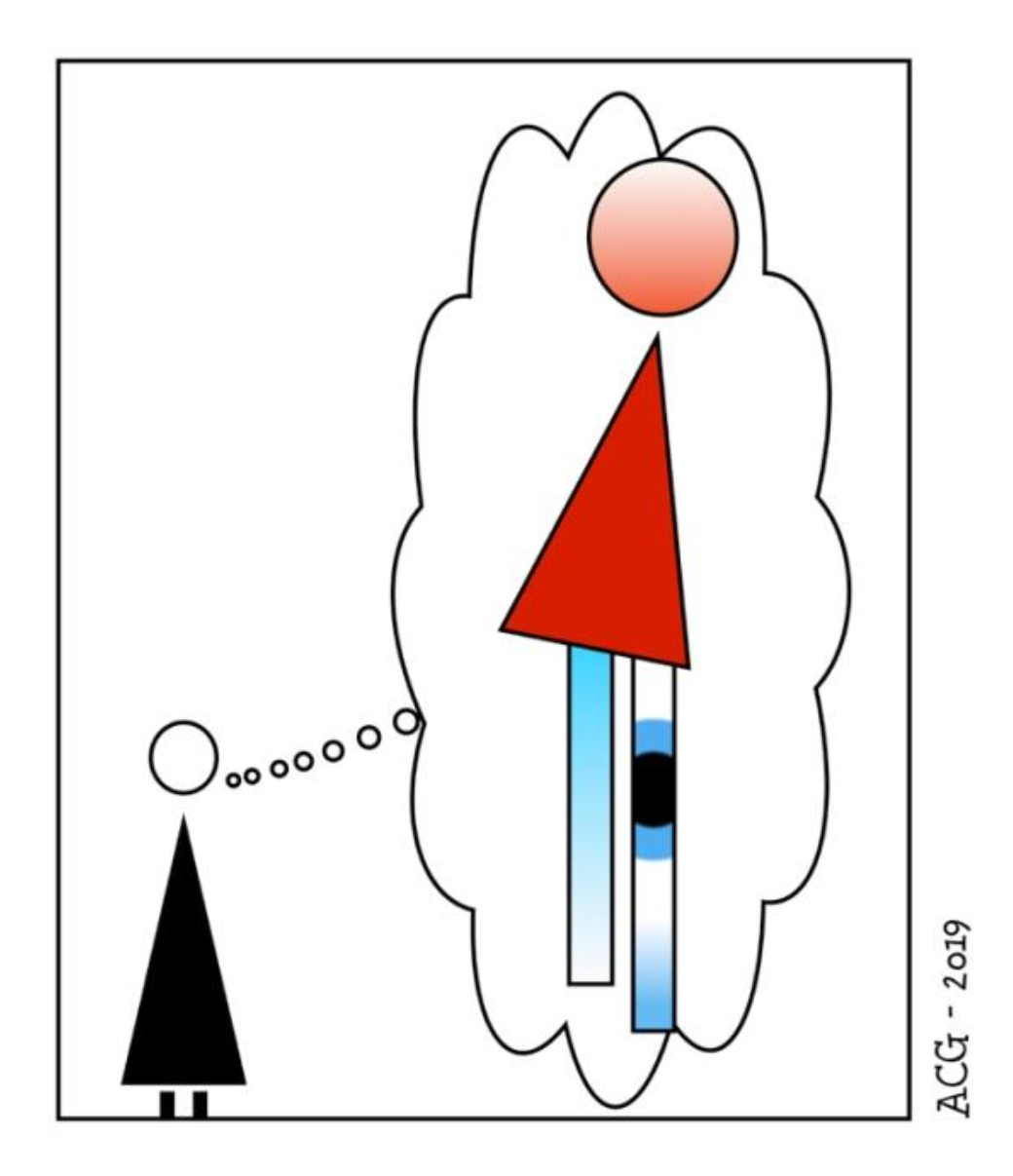
In any case, this is how I regard these forms: Over time, we have developed certain ideas about our body. And these ideas determine how we perceive ourselves and our body in the world, how we think our body. These conceptions can be variable, just as the body itself changes over time. But they can also remain relatively stable, even though the body changes. This is interesting to observe.
For many observations we have invented highly refined conceptual distinctions, and when they prove useful, they usually remain with us for quite some time. Such as the concepts "brain," "arm," "leg," "nose," and many others.
About our Contact with the World
We are not merely part of the world — we "stick" to the world. We cling to it, much like a dental prosthesis ideally adheres to the jaw. With our feet we stick to the ground (most of the time); with our fingers we stick to objects; our eyes stick to signs; the tongue sticks to lips (our own or those of others); and sometimes the nose sticks to a flower. In any case, odor molecules attach themselves to olfactory receptors. In addition, we are always hearing, unless we are or become deaf. Sound waves penetrate inward and touch us.
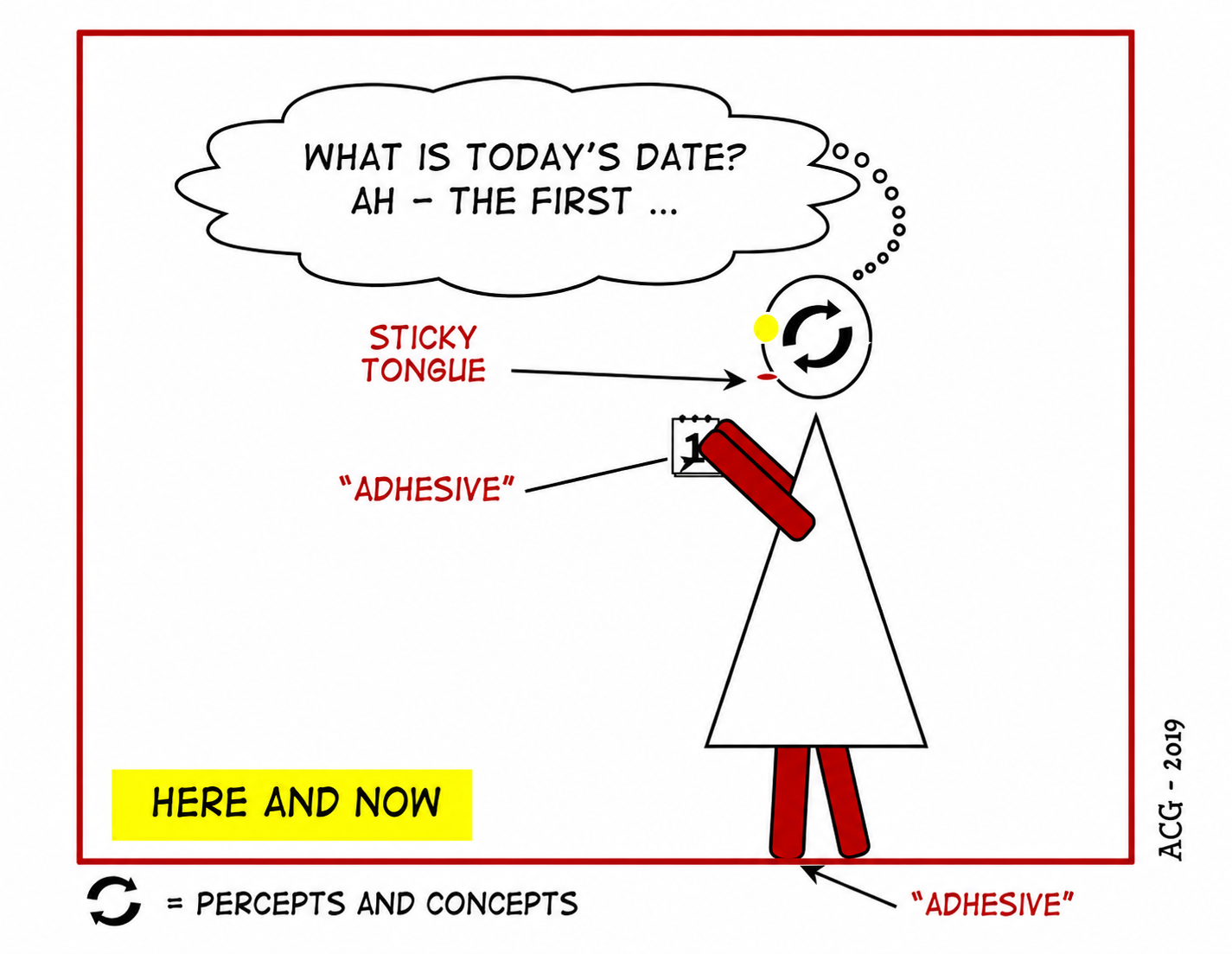
Here, a human being embedded within an environment comes into contact with the world visually and tactually through conceptualization — that is, through conceptually grasping. Perhaps the person also smells something and hears something that we ourselves cannot hear here.
Through our constant contact with the world, we continuously create embodied differences.
At no point can we step out of our contact with the world — not even in weightlessness, because even there we touch the walls of the spacecraft and perceive boundaries. Our "film" keeps running continuously as long as we are alive. We cannot not think our body, because embodied feedback processes constantly remind us that it is there.
Nor can we not think the "world," because we continually sense it; once we have understood sensing and grasping as such, we can no longer prevent them. At some point we arrive at the apparent certainty that the "world" is simply there, independently of us as observers. After all, we have grasped its existence often enough; there seems to be no reason to deny its existence.
Likewise, the understanding of corporeality becomes increasingly self-evident over the years, until we begin to believe that a body exists "in itself," detached from those embodied feedback loops and continual touches (the contact with something external) that help and helped us arrive at the idea of "bodiliness."
Processes that constantly repeat themselves become so automated over time that they eventually appear to function "by themselves." Under certain circumstances, we may then assume — even in philosophical contexts — that we can simply overlook automated processes because they appear banal in some sense.
Here, I attempt to allow that which is all too self-evident to enter the consciousness of us observers.
On the Metaphor of Calculating Realities
What do human beings have in common with calculating machines? Nothing. I think this is as simple to understand as it is to illustrate.
So what does Heinz von Foerster mean when he claims that we "calculate" our realities:
Perceiving → Calculating a reality.
(The arrow here is intended to mean "can be interpreted as …") (Foerster 1985, p. 67)
And supposedly this occurs in a non-trivial way as well. Is this metaphor really appropriate? Not really. After all, who else would come up with the idea of being a TI-30? But perhaps that is not what is meant? Then what is meant?
I would say that there is something fundamentally problematic about the whole approach. This becomes evident, I think, when one draws oneself as a TI-30 calculator — or as a punning bee.
We hardly "calculate" our realities in the literal sense; mentally, we do not form sums or products. Rather, we exist in constant contact with ourselves and with our world, and in every moment we shape our worlds (and ourselves as observers) through conceptual grasping.
We feel out our realities. We touch ourselves; sometimes we even poke ourselves, where we could instead be stroking ourselves. We build embodied patterns of movement and touch, remember how something feels, and then either seek out that something again or recoil from it and avoid it — for example because it stings unpleasantly.
The distinction between trivial and non-trivial systems is also logically incorrect. Since we cannot look inside living systems (in contrast to machines), we cannot make any statements about their "internal structure." We cannot say whether a living system is structured in a "trivial" or "non-trivial" way.
In Heinz von Foerster's distinction (Foerster 1985), this is a logically incorrect distinction, just as his "computational arts" cannot be applied to human systems, because biological systems have nothing to do with mathematical ideas.
Not being able to say something means not being able to say it.
We can examine which areas of the brain are more or less active in certain individuals while they are performing specific tasks. We should not overlook the fact that neural structures are individually interconnected (no two brains are exactly alike). The brain enables us humans to produce behaviors, always in a specific here and now, that is, depending on the respective context. It is constantly changing, just as the outside world is constantly changing.
On Patterns and Structures
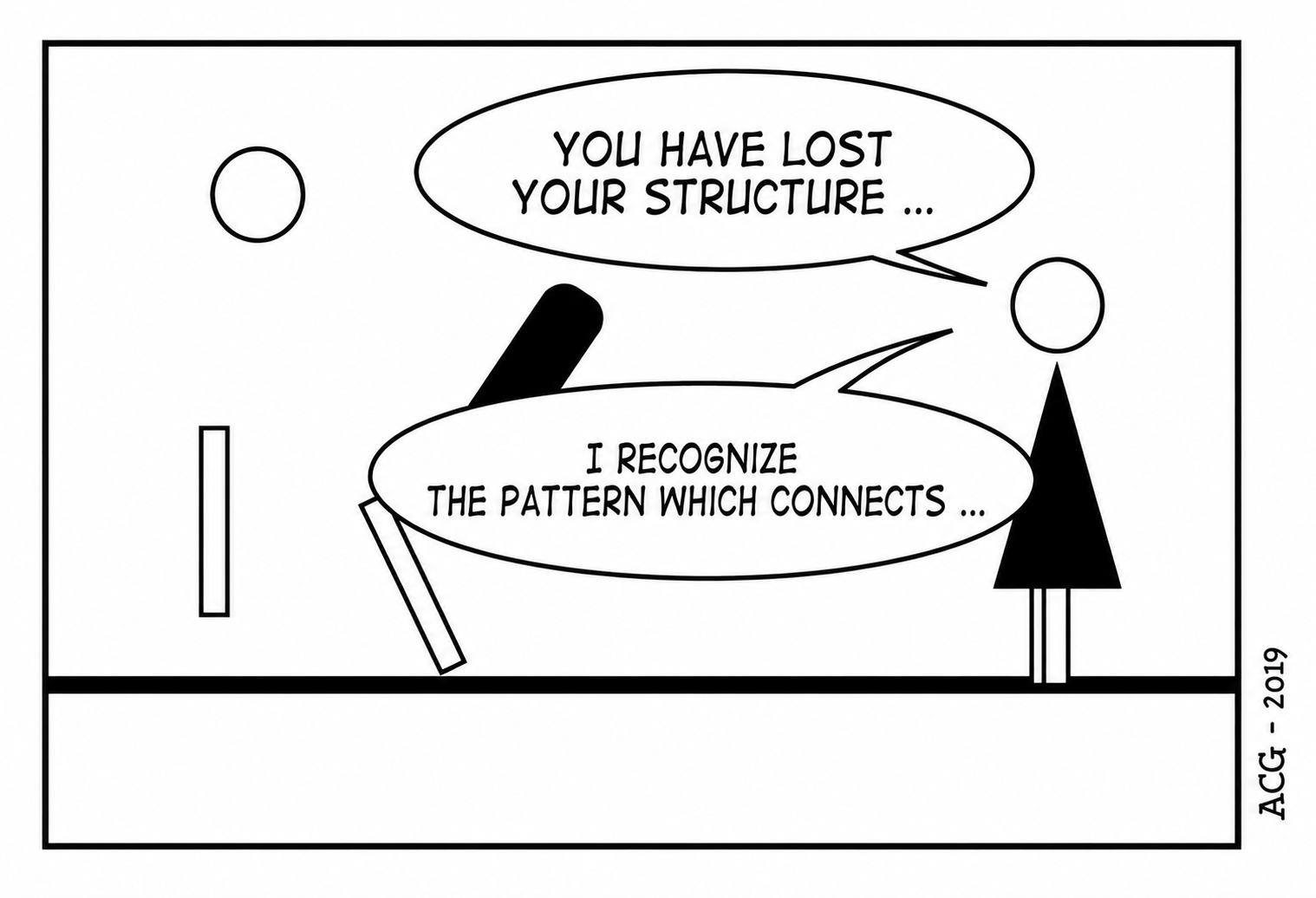
Patterns are established subjectively through repetition. When patterns generated by repetition become consolidated, we can speak of a structure. Anyone who completely loses their structure dissolves. Both physically and psychologically. This always happens simultaneously. Anyone who "loses" their subjective movement and touch patterns (learned sensorimotor patterns) cannot formulate a meaningful concept in the here and now; however, with some outside help, this can be restored, depending on the structure currently present.
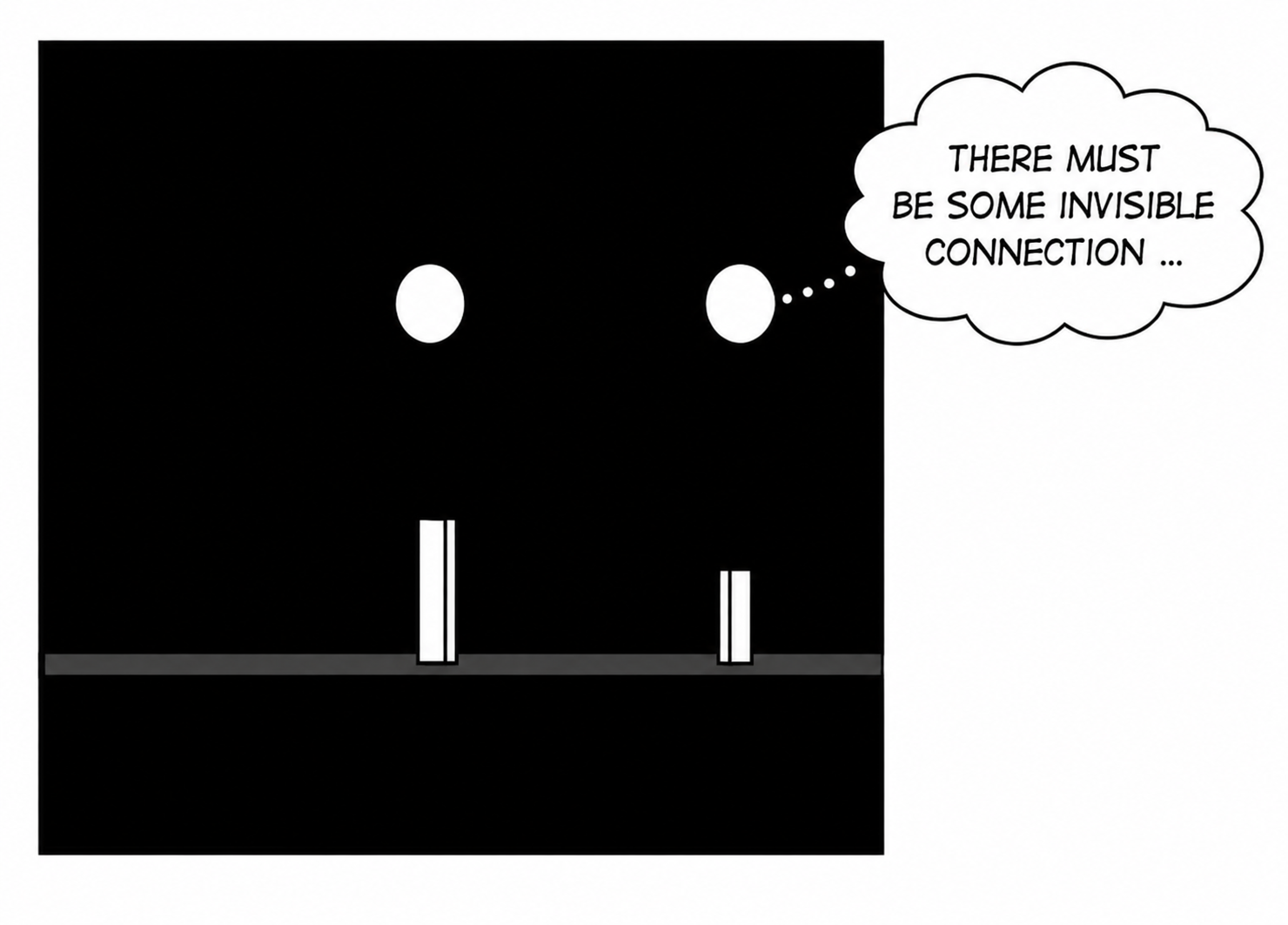
The recognition of a structure depends on the observation of an observer.
One can even go a step further and say: The existence of a structure is contingent upon an observer's observation. Now, through a small linguistic trick, we find ourselves on the plane of being, on the ontological plane, not exclusively on that of cognition. When we turn our attention to what is to be grasped conceptually, to what is actually perceptible in the here and now, we find ourselves on the level of being. The separation of two worlds—the one we grasp conceptually and the one that is—has become obsolete. Nor do I approach a reality conceptually, but rather it is what I can grasp conceptually in the here and now. If a structure may appear to us as absolutely existent, it can nevertheless be shown that any structure is conventionally real. This means that a structure must be regarded (let us not forget the observer who observes) as conceptually grasped; this naturally applies to the human body as well. Certain conditions must be present for us to grasp its structure in a certain way. In any case, the light should be on. If it is pitch dark, we can move through the room by feel. Objects that we now perceive haptically will have a different structure in our mind's eye than objects we perceive visually. Which structure is now "more real"? The visually perceived structure or the haptically comprehended structure? Neither.
Both are as real as we are able to conceptually grasp them in the here and now.
On the Power of Projection
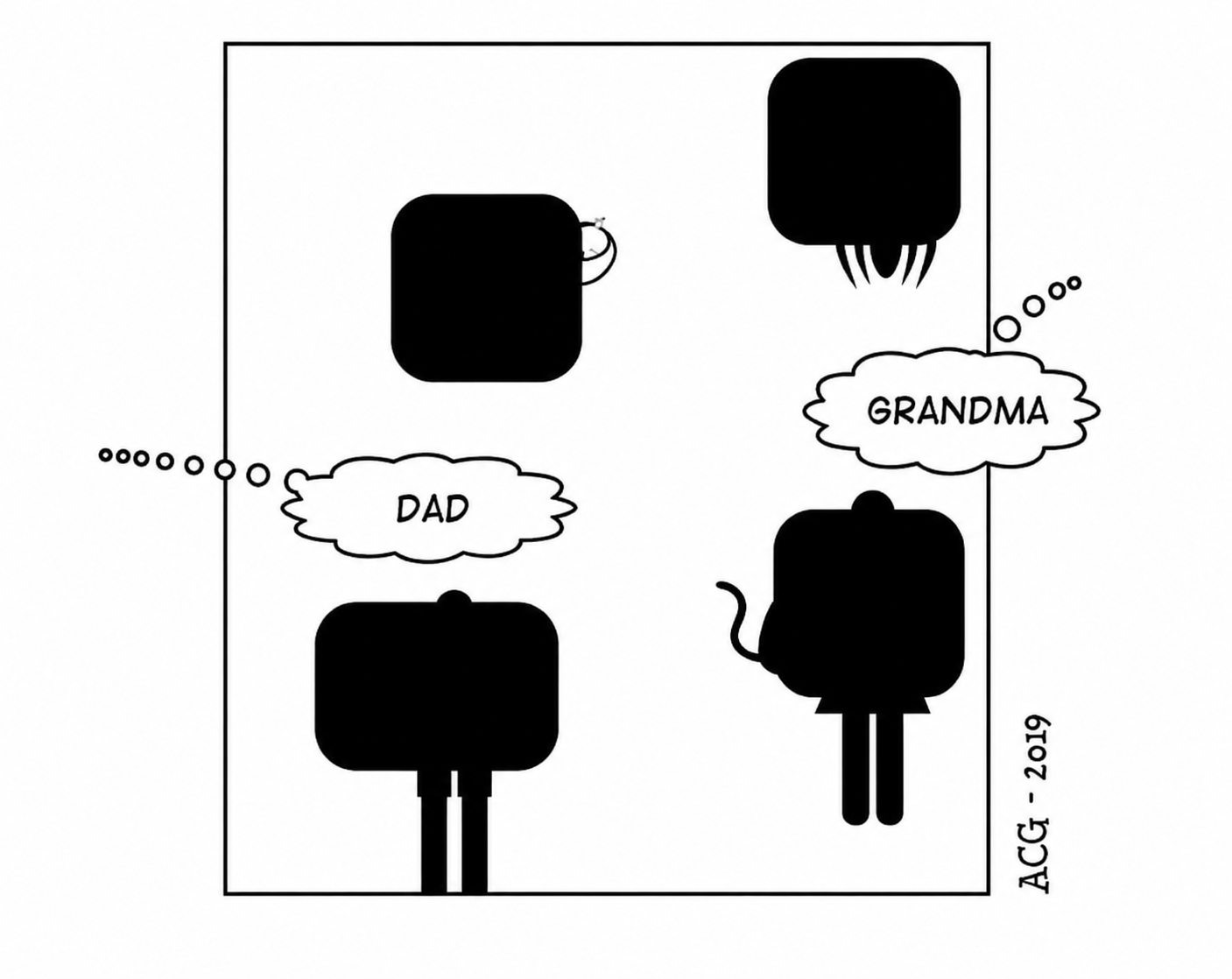
We see figures, meaningful forms, where from a stimulus-related — that is, a physical — perspective, none are actually present. This beautifully demonstrates how we constantly project our concepts into the world. And this can occur entirely without psychoanalysis. In this context, psychoanalysis speaks of transference and countertransference, meaning that we behave toward certain people as if a familiar person (mother, father, etc.) were present, rather than the person we are actually encountering here and now.
Transference (or countertransference) is a form of the
projection of concepts into the here and now that does not fit
the here and now.
Yet what is fitting often first has to be learned. That means learning new concepts, learning that already existing concepts may have nothing to do with the present moment. In the here and now, through contact with a stranger, we ideally learn new conceptual distinctions; we expand our way of seeing. Just as, when meeting someone we have never seen before, we always learn a new name — even though there is still the danger that the "new" name reminds us of an "old" one, causing us mentally to group these people together in one category, even though they may have nothing to do with one another.
We always encounter the here and now with preconceived attitudes,
with concepts that have already been learned.
If we wish to see the world differently in the here and now, then we must necessarily learn new conceptual distinctions, inwardly point toward new aspects, and conceptually comprehend the world anew. Otherwise, we will experience nothing new.
In the act of observing and conceptually grasping the world, a constant formation of concepts and perceptions takes place — a permanent shaping of the world.
For this to happen, however, we must have had — or must have — some kind of living experience with something. Put differently: nothing comes from nothing. Naturally, we are not consciously aware of all our concepts. We cannot talk about everything. But we can gradually become aware of them, especially the "usual suspects" (mother, father, grandmother, etc.).
And we can strive to learn new conceptual distinctions, to generate movements and patterns of contact that we have never produced before. And almost as if by magic, these newly generated movements and contacts will also bring forth new forms in the world — along with all the wonderful, and perhaps also problematic, consequences that arise from them.
We project our own form of gestalt perception into other living beings. They cannot defend themselves against this at all. This anthropomorphism is so widespread in everyday life that one can easily provoke the resentment of dog owners (and cat or guinea pig owners) if one draws attention to their ways of perceiving and explains the limits of these perspectives. Dogs (cats, guinea pigs, etc.) also possess species-specific conceptualities — concepts that are learned through repetition and always in dependence upon the physiological constitution of the respective animal.
Dog-worlds (or cat-worlds, guinea pig-worlds, etc.) can only be imagined by humans to a limited extent, depending on our ability to imagine our own existence transformed — namely with four paws, a dog's nose, fur, and so forth. I must honestly admit that I am hardly capable of doing this. I can most easily imagine the fur, but a wagging tail? Perhaps virtual reality (I am thinking of VR goggles) could help me and my limited imagination somewhat? Yet even before putting them on, I suspect that this will not work, because virtual worlds are themselves designed through the conceptual eyes (and hands) of human observers, not through the conceptual eyes (and paws) of dogs (perhaps in cooperation with guinea pigs).
Of course, we can describe how animals behave from our perspective and construct the most varied explanations of what may actually be happening within them. But since we cannot ask animals — and even if we could ask them and they could speak, we would still not be able to understand them fully (among other things because they are physiologically structured differently) — I believe that a certain humility toward the "object of investigation" is appropriate.
Perhaps cats experience almost unbearable fear when being washed. Or guinea pigs when they are locked into cages that are too small. We do not know this with certainty. And if we do not know something with certainty, it seems sensible to me to treat living beings (of every kind) with care and gentleness.
On Optical Illusions
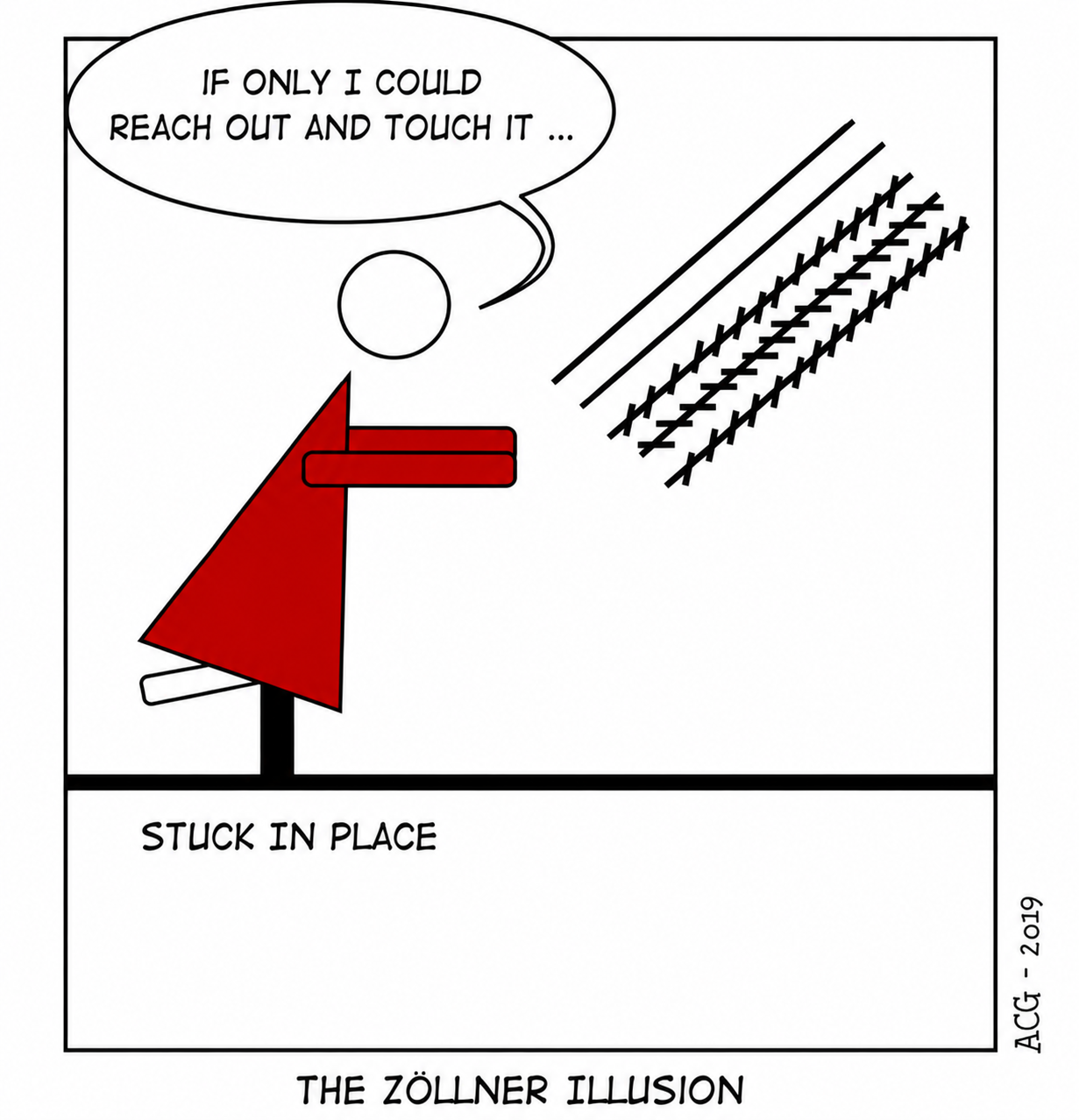
So-called optical illusions beautifully demonstrate that we ordinarily do not assume that we are being (visually) deceived. Otherwise, we would not need to artificially construct optical illusions in the first place. There must be a world that does not deceive us — the other side of the distinction.
Optical illusions always dissolve once we can reach out and touch what we see. Here it becomes apparent how important it is not to rely solely on the deceptive sense of sight, on reflections of light, but rather to be fully present in the world through conceptual and embodied grasping. Otherwise, one may quite literally be led around by the nose.
Optical hallucinations may be understood as concepts without a corresponding stimulation of the retina. We constantly employ this fundamental mechanism of projecting meaning outward. Could we therefore also say that we are all permanently hallucinating? Not really, because the difference between actual hallucinations and our shared reality is that we can agree upon our real hallucinations in the here and now, that we can physically grasp something, and in this way make it experientially accessible to others in the here and now as well.
If, on the other hand, I conceptually grasp something that only I alone can perceive, something that others cannot grasp or feel, only then is someone truly hallucinating.
In this respect, the concept of hallucination is indeed justified, because what is hallucinated cannot be touched, cannot be grasped. It is a fantasy figure, an imagination accessible only to the person currently hallucinating. But hallucinations, too, pass away — just as everything passes away with time.
Of course, we cannot grasp everything haptically. Sometimes we have no choice but to rely solely on our sense of sight, together with all the difficulties that this entails. And there truly are difficulties involved, as optical illusions vividly demonstrate. When we cannot reach out and touch something because the object of investigation is too small or too far away, we may employ our other senses as aids, along with technical instruments that replace our hands. For example, we can send a remote-controlled robot to the moon or sequence genes without literally touching them. We know how to help ourselves when the world becomes infinitely large or infinitesimally small — larger or smaller than our fingers are capable of grasping.
On Visual Perception
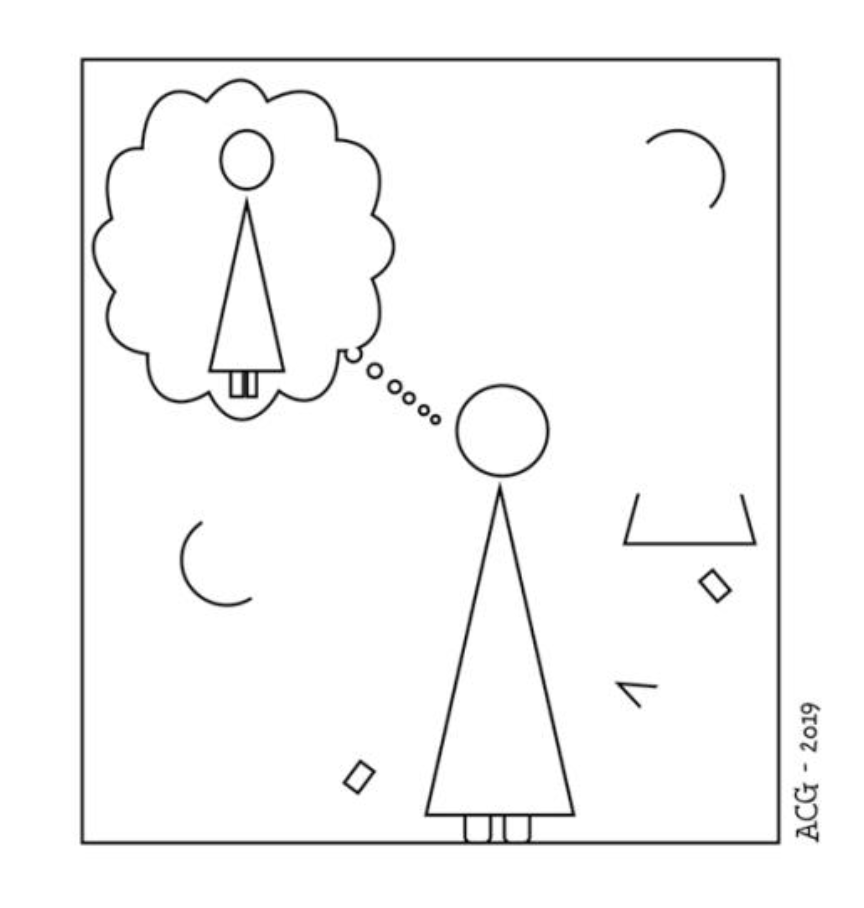
We form wholes out of parts and, conversely, conceptually divide something into individual parts through distinction. Our imagination is virtually endless. In my view, it is important to become aware of the process of conceptualization from time to time.
We also see more than what is actually drawn or depicted — provided the appropriate description accompanies it. Here again, one can observe how our concepts and our percepts are always intertwined as soon as we see something as something (seeing x as x).
We form unities out of identical or similar visual percepts and concepts, so that, for example, we may overlook individual human beings and instead perceive them as a quantity, a mass, or a people. When we group animals into unities, we call them a "swarm," a "herd," a "pack," and so forth. Some people also see the "Great Bear" or the "Little Serpent" in the sky. And naturally, through language and conceptual distinctions, one can also extract individual parts from the whole again, simply by saying, for example: "Look, that star shines especially brightly!"
That we are able at all to see something as a something should by no means be taken for granted — although, of course, by now it largely is. We have simply grown accustomed to it. And once one becomes accustomed to something, one eventually stops wondering about it. Perhaps. At some point. But perhaps not.
We automatically imagine something that is farther away as "larger" (in the mind), so that the proportions fit again overall. It is simply practical to live in a coherent world.
And something else that is almost banal: We only see what enters the focus of our attention, what we actually look at. The marginal remainder, logically, we do not see in the concrete here and now — at least not consciously. And if something is not conscious to us, then we know nothing about it. Otherwise, we would not speak of the unconscious.
But it is not quite so banal after all: One can look somewhere and nevertheless not see something; one can simply overlook it — either because one does not know the aspect at all, because one is attending to something else, or because one does know the aspect but simply does not expect it in that particular place (see also Simons & Chabris 1999). Something does not fit the pattern, does not fit the context in which one expects it.
Our expectations within a particular context constrain what is possible.
We also perceive something according to its use. If something, for example, fulfills the criteria for sleeping on it, then we call it a bed, sofa, or couch, and we use it in that way. If something does not fulfill these criteria — because, for instance, it is too hard — then we do not call it a bed (but something else).
Of course, there are also "borderline cases" concerning the use of an object; that is, what something is or is not in the here and now need not always be clear-cut.
The hardness or softness of reality in the here and now must always be regarded as relative, not absolute. Some people prefer hard mattresses over soft ones, whereby people experience this hardness or softness subjectively, even though we can speak about it intersubjectively and designate or shape mattresses accordingly. Otherwise, the concepts themselves make no sense at all.
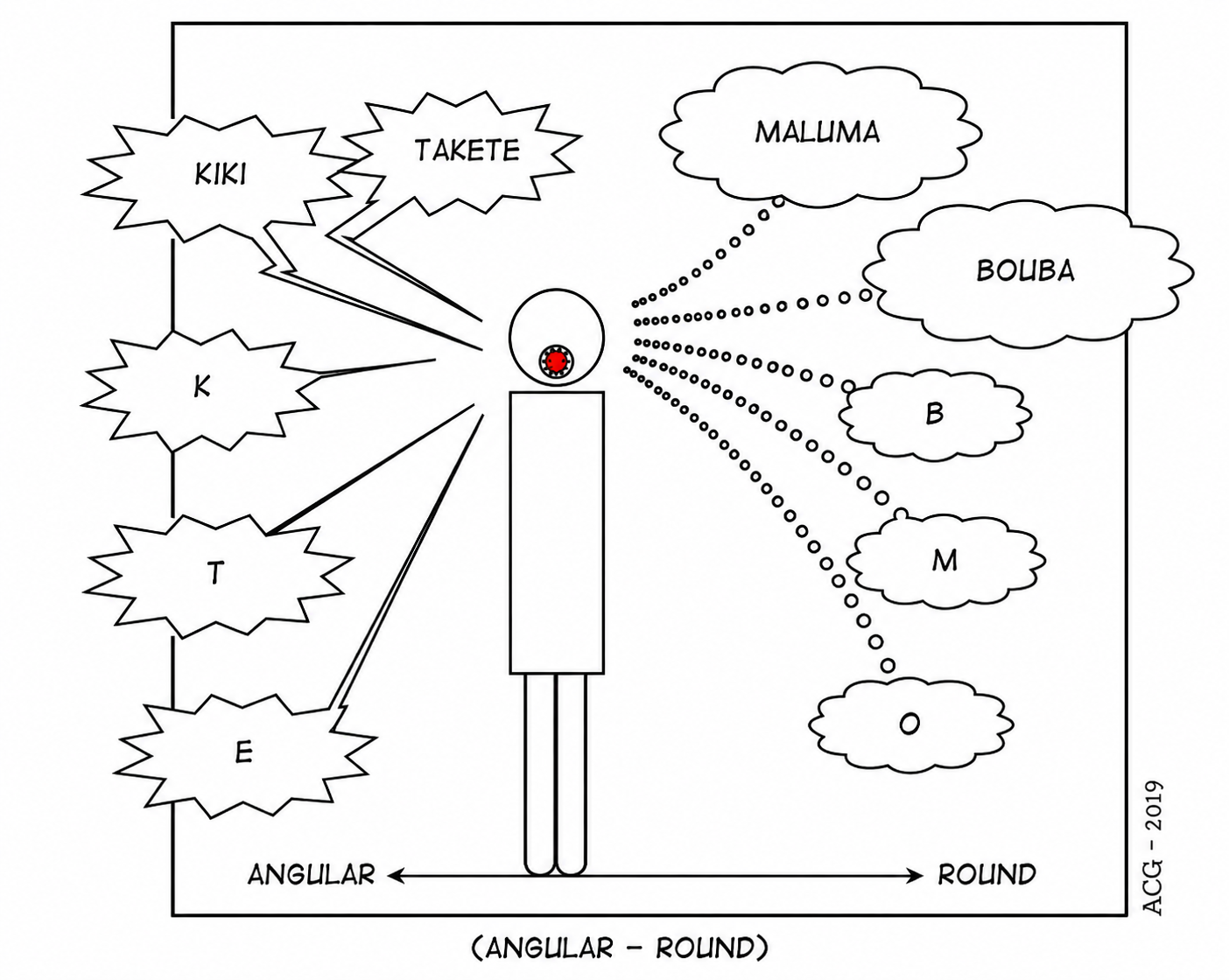
So-called synesthetes, for example, hear colors or see letters in color. They perceive conceptually more than is physically present in the stimulus. This is a logical phenomenon, since concepts and percepts are intertwined. The concepts are generated by the observer, whereby there is obviously no fixed "quantity specification."
Empirical studies have repeatedly shown that certain forms are frequently associated with particular sounds that seem to fit those forms. Terms such as "takete" or "kiki" are usually assigned to angular forms, whereas terms such as "maluma" or "bouba" are usually assigned to rounded forms. In the experiment, the following question is asked:
"In Martian language, one of these two figures is a 'bouba' and the other is a 'kiki', try to guess which is which."
(Ramachandran & Hubbard 2001, p. 19)
This phenomenon was first described in the 1920s by the Gestalt psychologist Wolfgang Köhler. Ninety-five percent of test subjects assign "kiki" to an angular form and "bouba" to a rounded form.
My interpretation is as follows:
Sounds are always bodily comprehended and bodily produced sounds. A rounded sound resembles — empirically and logically speaking — a rounded, comprehended form, because every form is embodiedly comprehended in order to be, for an observer, a "rounded" or an "angular" form.
On Feelings
Someone can say something that strikes us, that awakens feelings. And presumably this is always the case whenever we talk or think about something.
For feelings are embodied patterns of movement and touch. And patterns of movement and touch are embodied thoughts.
Feelings make us feel something. It is as simple as that. And thoughts, too, make us feel something; they touch us inwardly. For even though we have the impression of speaking inwardly, we do not have ears inside the brain. Yet while speaking inwardly, we very much do touch ourselves internally. We generate sensorimotor patterns that we also require in actual speech in order to repeat sounds in a sufficiently similar way so that they may also be understood by others as these specific sounds.
And when we think inwardly (which can only be done inwardly), we silently repeat precisely these already sufficiently often repeated — that is, learned — sensorimotor patterns.
A separation between emotion and cognition, entirely in the spirit of Luc Ciompi's concept of Affect Logic (Ciompi 2019), cannot truly be maintained. Rather, we generate such a separation conceptually; otherwise, we would hardly have invented the two concepts "emotion" and "cognition" in the first place.
Women in particular live dangerously in relationships! Emotions can virtually bring people to the point of explosion — though, as a rule, they do not literally explode, but instead direct violence toward other people and/or toward themselves.
We say that someone "puts us under pressure," that "inner pressure is building up," that "we need to let off steam," and so forth — but what exactly do we mean by this? Which "forces" are at work here?
What is Luc Ciompi writing about when he writes:
"First and foremost, it must be emphasized that Freud is certainly rightly regarded as the founder of modern psychodynamics, that is, of an approach that moves far away from a linear-causal view of psychic processes of the stimulus-effect type and toward a mode of thinking in which dynamically oscillating processes between two (or more) poles, tension regulation, states of equilibrium, and compromises as results of the interaction of various forces play a decisive role."
(Ciompi 2019, p. 21)
Which forces? Which tension? Are we talking here about "energy"? And if we are talking about energy—for what else could we be speaking of when we speak of forces—then could concepts themselves also be considered "forces"? Why not? They are generated through the power of a body, a body that continuously absorbs and releases energy. But how peculiar it is that we use the expression of force when speaking about psychic processes!
Logically considered, pressure can only build up in a system if something is also "introduced" into the system. But perhaps there is something wrong with this metaphor of "rising pressure," after all, we human beings are not pressure cookers.
Since our concepts, our cognition, and our emotionality are, in my view, intertwined through sensorimotor patterns, we can also learn to regulate our emotionality through our concepts.
But physical contact can also fulfill this function, that is, cooling down heated emotions again. Just like a good conversation (for example with a priest), alongside many other possibilities (a bubble bath, a mountain hike, a dive, a scream therapy seminar, etc.).
The Power of Repetition
Meaning, or form as meaningful form, emerges as soon as an observer repeats a conceptual pattern.
Meaning stabilizes through the repetition of embodied concepts.
While philosophizing, we could more often turn our attention toward what appears self-evident. Or, to quote Günther Anders:
"The philosopher's chance lies in his inability to understand the word 'self-evident.' His virtue lies in the ability to sustain this inability despite all the challenges of everyday life."
(Anders 1993, p. 124)
Only the repetition of a pattern of touch leads to the form "pattern of touch." Only the repetition of a bodily form, for example the articulation of a sound, leads to the recurrence of a sufficiently similar sound. Learning to speak means learning bodily forms, similar to learning ballet dancing or skipping rope. We practice repeatable patterns until they are taken for granted. The task of a philosopher may consist in reconstructing this process.
On Discipline and Free Will
Discipline — a concept that evokes the image of a Chinese military parade. I mean the ability to control my thoughts and feelings in such a way that at the end (and at the beginning) I do what appears meaningful to me, rather than what would correspond to my emotional state if I simply let it run free.
Discipline may perhaps be just another expression for the will.
My will (and here I can speak only for myself) is an inner force — here again we encounter this peculiar expression of a psychic force — that I am able to mobilize, provided that my ego is sufficiently strong.
On "New" Thoughts and Concepts per se
I have claimed that we cannot see "thoughts"; they appear to me to be just as invisible as thinking itself. And yet I can do something in order to arrive at new thoughts. New for me, mind you. Presumably someone else has long since thought them before me, in one way or another.
When nothing comes to mind (which does happen), a somewhat absurd jumping dance sometimes helps me regain mental momentum. Fortunately, nobody lives in the apartment below me. I perform movements that I do not ordinarily perform. And immediately, something within me begins to move as well.
We can usually choose where we look. And we can usually choose whether we listen.
But once we do listen and once we do look, we unfortunately cannot choose what we hear and see. That means: once we have decided to listen and to look, we consciously direct our attention toward the auditory and visual stimuli presently available. And the moment we proceed in this way, we have already conceptually grasped something — namely those stimuli that are present in the here and now.
I can pretend that it is not night, close my eyes in order not to see the darkness. But once I finally open them, I cannot pretend that the lights are on. I can also sing so loudly that I hear nothing else. Yet when I stop singing and listen attentively, I cannot pretend that no bang has just sounded.
Can I perceive the bang not as a bang, but somehow differently? Or, once I attempt the opposite, have I not already conceptualized it as a bang? In any case, I cannot pretend that I have perceived no difference at all — no matter how I conceptualize this difference.
Since particular concepts are always embedded within a particular context in order to be these particular concepts, I also cannot pretend that I am hearing a song by Franz Schubert when in fact I am merely perceiving a loud bang. And a Schubert song does not suddenly become a song by Gustav Mahler. At least I can distinguish the two quite well from one another — at the latest when I read on the CD cover what I am actually supposed to be hearing.
Of course, if one of my children had switched the CDs, then I would form a false opinion on the basis of false assumptions — unless I could remember with certainty that Schubert does not sound like Mahler.
I do not need to listen to every single piece by either composer in order to grasp what is characteristic about them. Just as I do not need to examine every individual human being in order to understand characteristics of the human being.
A category or a concept may be very general and only become conceptually refined within the concrete here and now.
Thoughts cannot be physically grasped. They are articulated: orally (as sound waves or longitudinal wave disturbances in air or water), in writing (in the form of letters or other signs; particles), visually (in the form of images, figures, arrangements, etc.), or both visually and in writing (as here).
One cannot see a thought when it is spoken.
One cannot see a thought when it is written down.
One cannot see a thought when it is visually represented.
For what one sees is not the thought itself.
Waves and particles (neutral stimuli) touch the senses.
They become meaningful only through the establishment of embodied differences, through repeatable concepts (patterns of movement and touch, that is, sensorimotor patterns) in the here and now.
A thought has no form. It is formless and fleeting, just like thinking itself. A thought therefore also assumes no absolute form within the brain, which is just as relevant for thinking as the body and its environment.
A thought arises and passes away communicatively in every moment.
What we store in the brain (and that we store something there is hardly disputed) are those embodied patterns that enable us to articulate or express something in the here and now — but not thoughts themselves, nor what is expressed in itself in the here and now.
For we shape these thoughts anew in every moment, depending on the context currently being conceptualized. We store embodied forms, and the more frequently we perform certain movements, the more the corresponding brain areas are engaged; over time, they reshape themselves accordingly (see the research on neural plasticity).
On Throwing Little Notes
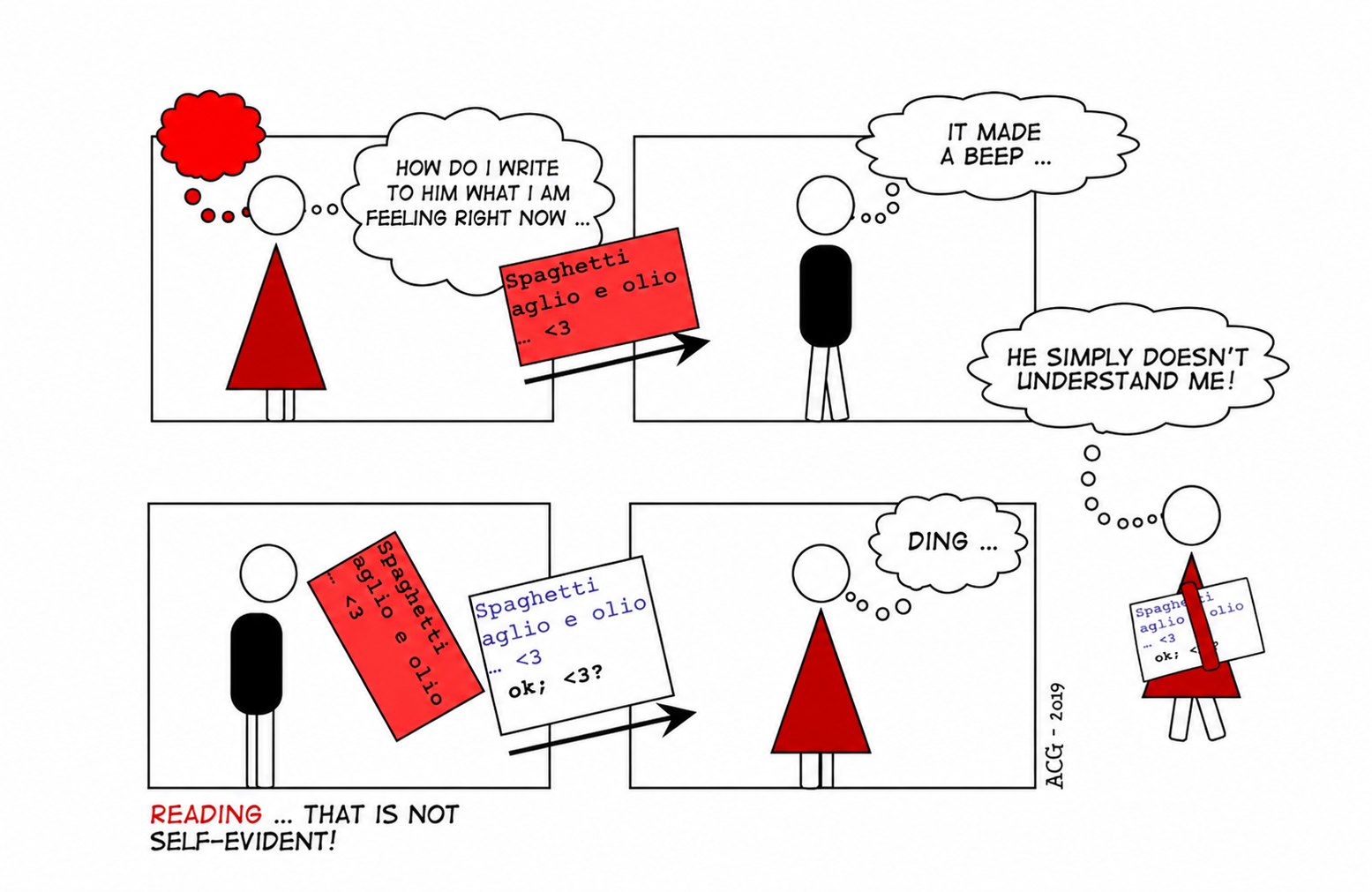
When we communicate by means of text, the "tube metaphor" of transmitting code is correct insofar as linguistic signs are indeed transmitted (meaningless forms on paper, or encoded wherever and however). Only in the act of reading or viewing does the form become a form endowed with meaning and sense.
Information arises the moment someone regards signs as signs or code as code. Reading means enriching letters (something drawn) with meaning by following rules.
Letters are not arranged arbitrarily, but according to rules. Grammar gives a text structure. And the rules of language use narrow down the possible meaning. Intersubjective language use in the here and now can therefore lead to understanding — but it does not have to.
On Presence
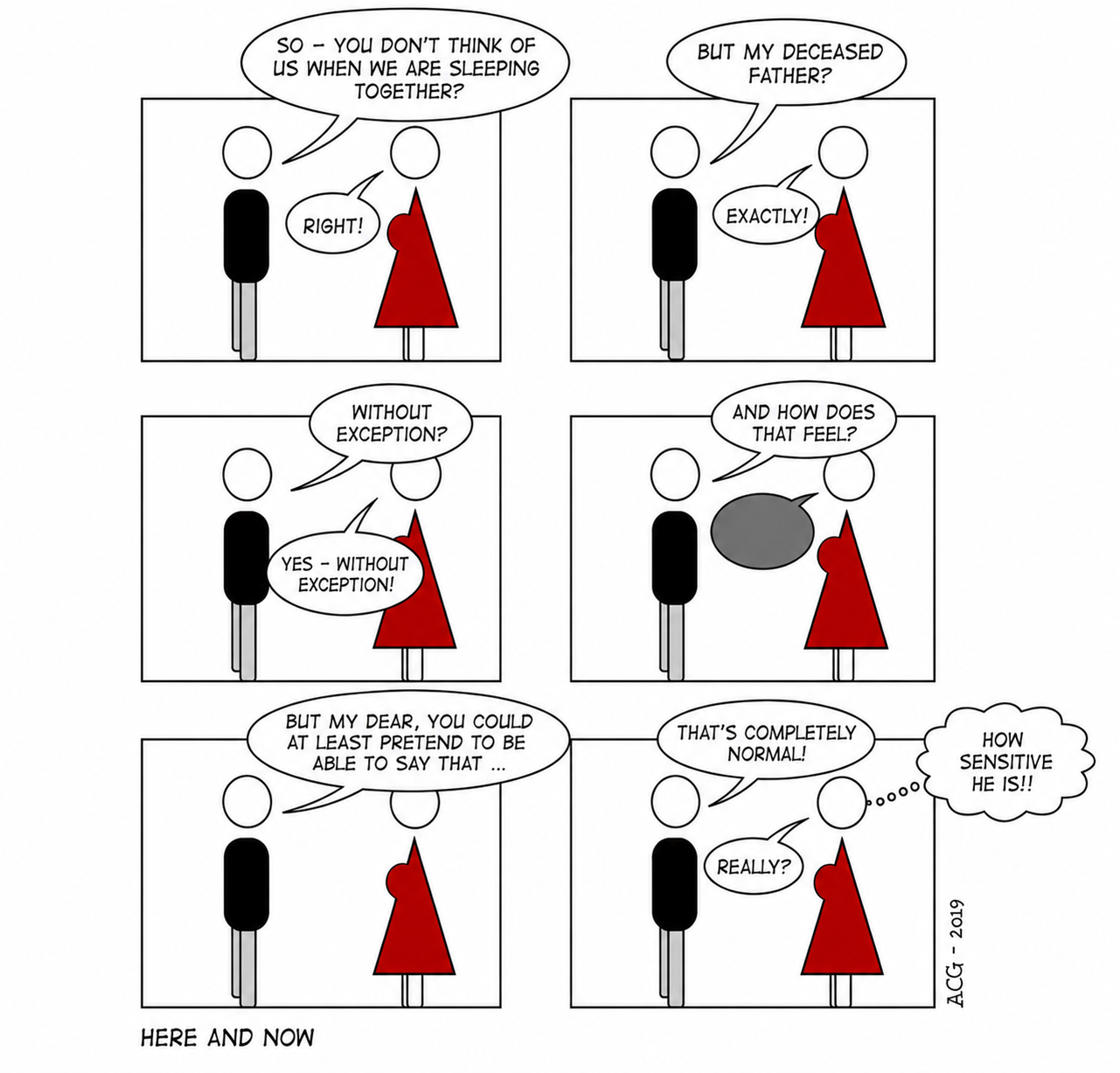
When Ciompi writes of a "harmonious convergence of bodily sensation and thought" (Ciompi 2019, p. 86) and, elsewhere, of "the elimination of tension-creating incongruities and contradictions between thinking and feeling" (ibid., p. 92) as a therapeutic goal, then, in my view, one can also speak of presence as something to be strived for. Physical and mental presence enable a form of tension reduction, a state that allows one to be physically and mentally "fully in the moment," to think what fits the sensations at that moment, and to feel what fits the (mentally) constructed context at that moment.
In my view, being present in the here and now allows for the greatest possible harmony between an organism and the current environmental conditions. We can look forward to seeing how the two protagonists continue to happily "experiment" with each other and what forms of suffering will eventually arise. Or are they already present?
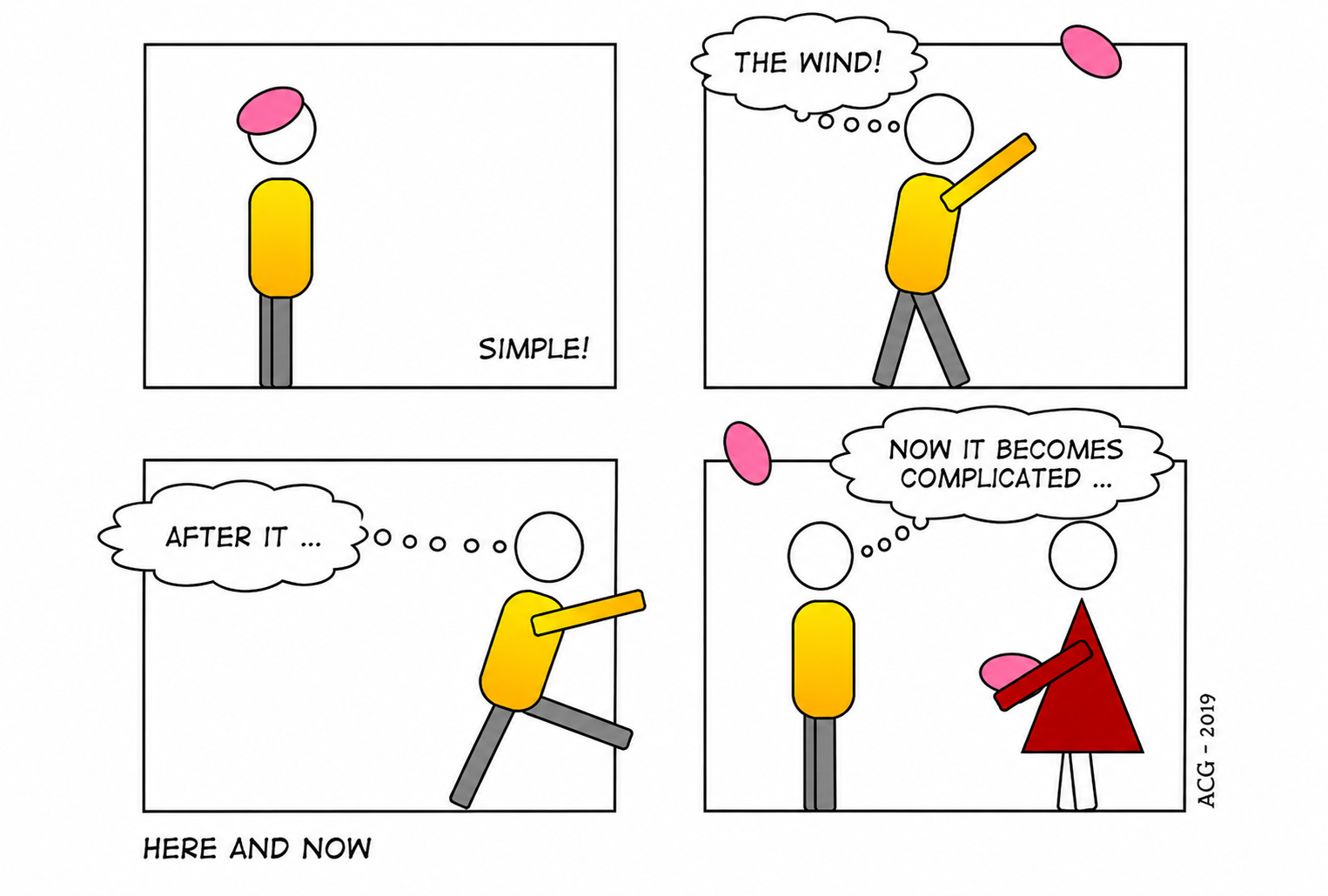
A lack of presence is probably the rule rather than the exception. But here there are presumably a wide variety of degrees of presence (on an imaginary continuum).
Our ability to recall, in the here and now, something that is not currently present is constantly playing tricks on us. This ability makes it incredibly difficult to be fully present. Some also speak of "memory," but this term is just as misleading as the term "psyche." Just because we refer to processes over time using nouns does not mean that these nouns actually exist, let alone that we can find them in the brain (or anywhere else) like Easter eggs. Our language creates almost endless confusion here, and we no longer know our way around. What we call our "memory" is the ability to reconstruct something in the here and now (embodied). Sometimes, however, we simply don't feel like doing that. But that doesn't mean we've lost a "part of our memory." Nor can we find the "psyche" anywhere, since it doesn't really exist. All that really exists are embodied processes of thought and feeling in the here and now. And always only in the here and now.
On Ethics
If the world (a hat) does not provide any "meanings," if it does not tell us what is right and what is wrong, then what is that "inner voice" that causes us to act "ethically"? Is it truly ethically justifiable to act in such a way that "the number of choices increases" (the so-called "ethical imperative" according to Heinz von Foerster; see Foerster 1985, p. 41)? This form of ethics means keeping as many doors open as possible. In such a case, one could also speak of opportunism. Or of blackmail. Many situations can be constructed that suggest that acting in accordance with the "ethical imperative" can actually achieve the exact opposite of what Heinz von Foerster certainly had in mind: acting for the benefit of others and not just for the benefit of one's own ego. Shouldn't compassion for all other living beings rather be the foundation of (ethical) action? But how do we cultivate compassion, and above all, for what purpose?
Does paying 50 euros instead of 20 euros to get your hat back really create more options? Not really. Rather, the offer to pay anything at all for your own hat creates more options. However, this offer, which creates more options, has nothing to do with ethics. That would be more the case if sound reasoning could persuade Pinky to return the hat that doesn't even belong to her. The power of sound reasoning—and not the power of money—determines whether we regard something as moral or immoral. And we don't just regard it; we don't just judge logically, but we also feel (in normal cases) also feel compassion for other suffering beings. Compassion arises naturally in all of us (with the exception of criminals who dismember women) as soon as we observe suffering. But as can also be observed in the case of criminals who dismember women, we are quite capable of seeing suffering and feeling nothing in the process. We can become absurdly desensitized. Therefore, one could (to prevent this desensitization) actively strive time and again to cultivate one's compassion. This feeling is a moral force unique to us humans, and one that ultimately leads to the fact that, by acting altruistically toward others, we always feel better about ourselves as well. If that isn't reason enough?
But how "should" we behave, then? It seems to me that if we feel the compassion that naturally exists within us—and, if we don't feel it, cultivate it— then we already know (in the here and now) what to do. And how do we cultivate this strange compassion?
Can we let it grow, like a plant? A first step is probably simply the thought of it, for as we know, thoughts give rise to realities, and when I think now about the last time I felt compassion for someone or something, then (as if by magic) it is already present again in the here and now. The more often I think about my compassion, the more frequently I feel it. Here, too, we see once again, very much in line with Luc Ciompi's logic of affect (Ciompi 2019), how our cognition and our emotion are intimately intertwined.
Here is yet another hypothetical scenario intended to show that increasing the number of choices has nothing to do with ethics. Not even remotely. Or does it?
On Power
If I am free to choose where to focus my attention, then I am also free. If other people (or even things) decide where to focus my attention, then they have power over me.
Fundamentally, we are always free to choose where to focus our attention (once we reach a certain age). Please take a moment to reflect on the previous sentence!
The power to "control" other people holds an immense appeal for quite a few people. And yet, one's own life is significantly more relaxed when one doesn't have to worry about other people (and where their attention is focused). Of course, this is a utopian ideal in everyday life. We automatically always pay attention to others as well, see where others are looking, and create shared fields of attention. Thus, we are constantly playing with our power, in different ways depending on our role (or context).
To be noticed means to be acknowledged. And if others don't acknowledge us, then we don't exist for them either. They don't have a concept of us. Should that matter to us?
Children must submit to adults; they simply cannot survive on their own (up to a certain age). Therefore, they must be regarded as particularly vulnerable. Children can be abused in many ways, mostly to satisfy the needs of adults. The damage caused often extends far into the future. But what does that even mean: causing "harm" to a person. I understand living systems as dynamic, constantly changing systems. Violations of a system (logically speaking) always constitute boundary violations. Despite all openness (or pre- and perinatal symbiosis), an infant, a toddler, a preschooler, an elementary school child, and finally a teenager and young adult learn to act increasingly autonomously in the world, that is, to autonomously close their own system. This is a learning process. Self-regulation requires external boundaries, that is, the ability to establish the cohesion of a system (despite all openness). This is easier said than done. Children need a warm, loving embrace for many years. And yet they increasingly learn to warm themselves independently, ideally to love themselves. This process can obviously be disrupted to varying degrees at different stages. (See Ciompi 2019 on the possibilities of familial "entanglements" and psychoanalytic and systems-theoretical interpretations; see Stierlin 1994 on the process of individuation.)
It seems useful to me to view people as both open and closed systems and to focus on the dynamics that make both possible at the same time.
Sometimes we simply have to accept that others have power over us—that is, they control where we focus our attention. Eventually, attention gets traded for money. Those who aren't paying attention make mistakes, thereby failing to play the game as intended, and are often replaced by someone who makes fewer mistakes (and is more attentive). The more automated processes are, the less attention we need to pay to them.
Sensory-motor patterns can become second nature (like riding a bike), and we can happily think about something else while drilling holes in peaches.
On Complexity and Rules
The world is incredibly complex. Yikes! And we humans are incredibly complex, too. The human body is complex enough, and then there's the mind—especially when we consider just the possibilities we can explore through thought. The question is, however: Why do we often not even perceive this complexity, or only when a brick happens to fall on our heads or our immune system goes haywire? We cannot group linguistic terms arbitrarily, because if we do, we violate grammatical rules, and are usually immediately called out on it. Nor can we answer questions arbitrarily; otherwise, we violate logical rules—those rules that allow us to speak in a way we have learned to regard as meaningful.
Rules are established through repetition.
Rules regulate something; that is, they guide behavior and coordinate it, like lines that serve as floor markings and must not be crossed. But there are no regulating "lines" within us humans; we simply learn rules through the repetition of the same thing over and over. Only later do we speak of rules, but even then, only when we reflect on the same thing over and over.
Rules reduce complexity.
Rules arise through the repetition of the same thing over and over. If we want to bring something new into the world, we must in any case break the existing rules. There is no other way. This is a balancing act between the normative and, if you will, the unregulated, until other rules eventually become the norm. But that can take time. Perseverance is recommended.
If we think of spoken language as a dance, then we can imagine that we perform a series of well-defined steps one after another in order to speak. We must follow these steps consistently so that we produce specific sounds (and not just random grunts and hisses). After all, fortunately, we don't just grunt and hiss when we speak.
Certain sounds are not formed in just any way; they have defined modes of articulation.
We generally produce sounds while exhaling, not while inhaling, even though we occasionally speak while inhaling. However, as a rule, we must exhale in order to speak, to let the air out.
Specific sounds are formed in specific ways.
These speech patterns become ingrained through repetition, and they can only be changed through repetition. For to repeat something is to learn the rules of how to perform it, even though one can, of course, question the sense and nonsense of these rules. After all, there is not just one language, but thousands. The complexity is almost overwhelming, and yet we humans manage to express ourselves in a way that allows and enables us, in the here and now, to be understood.
To be able to understand something, one must know the rules that underlie what is spoken and then, in the here and now, not perceive any noticeable differences between the "foreign" rules and the "personal" rules. This usually happens implicitly, meaning we have no explicit knowledge of rules that we have learned implicitly (through repetition).
On Children
As we all know, children are not just little adults. They are born, and we adults are privileged to accompany them for a while. But in what sense, exactly? Perhaps we have certain ideas about what a 'successful life' looks like? Perhaps not. Every age has its own developmental challenges, which also vary from child to child. The matter is – once again – very complicated. Whilst one child can walk at ten months, another only displays this strange behaviour at 18 months. There are developmental milestones, that is, a defined age at which children should be able to walk, speak, eat independently, etc., in order to be classified as normally developed. The scope of what is considered 'normal' in developmental diagnostics is usually set very broadly (for example, a percentile between 16 and 84), so that as many variations as possible within the normal range can be accommodated, but also so that targeted support can be provided if there is a need to catch up in certain areas.
Since children cannot look after themselves, at least not as toddlers, one can never view their actions or inactions in isolation from the social environment in which they grow and thrive.
Each child's individuality becomes apparent postnatally in their behaviour, that is, as soon as we are able to observe and categorise them. As long as they remain safely sheltered in their mother's womb, they are relatively safe from our constructs or descriptions. Unless, that is, we produce prenatal ultrasound scans and categorise them according to developmental norms and potential malformations. This can lead to difficult decisions, for instance when new life develops outside the so-called 'norm'. If one does not look into the 'surprise bag', then one does not have to grapple with such decisions. There can also be advantages to not knowing something. And if one does not look inside and the images are not interpreted, then one simply knows nothing. If anyone now thinks that the baby "nevertheless" exists, even if no one conceptualises it in any way as a "baby", directly or indirectly (blood tests, weight gain and increase in the chest and waist circumference of the expectant mother, etc.), then that person has already opened the "box" and looked inside. There can also be advantages to knowing something. However, once you know something (have opened the surprise bag), you can no longer pretend not to know the contents. You cannot deliberately forget what you once knew, for every attempt in that direction only strengthens the memory. Much like the paradoxical instruction: "And now don't think of a pink elephant!"
If the technology and knowledge to interpret ultrasound images are available, then we must learn to live with this technology and critically reflect on our actions, on whether we look or look away. In other words: decide whether we want prenatal knowledge about the physical form of the unborn child, or not. Some children are calm, balanced and at peace with themselves from birth. Others cannot sleep, are restless, cry a lot and find it very difficult to settle. And naturally, this applies to their carers as well. Sometimes only the mothers or only the family structure are held responsible for the behaviour of infants or even cry babies. But of course, it is not quite that simple. In the context of a biopsychosocial approach, the behaviour of the little ones may be rooted in a physical discomfort (have organic causes) and/or social causes (bonding, handling, etc.). It may also have no discernible causes at all, but simply be the way it is. For whatever reason. All of this is possible and should be taken into account. The fact is, however, that this can be the case. This is an indisputable description of a situation.
In any case, an infant's daily crying for hours on end over a period of weeks always has a detrimental effect on the parent-child relationship and can lead to a sense of helplessness or even the use of violence on the part of the parents. In such cases, it is important to seek support as soon as possible and break the vicious circle (paediatrician, midwife, etc.). The longer such a vicious circle persists, the more detrimental its effect on the development of a child who is 100% dependent on a loving parent-child relationship.
On Normality
What is normal is what someone regards as normal in a particular context, but there can be no absolute criterion. Similarly, it is impossible to pinpoint normality within the brain, because it is social criteria that determine what fits into the respective environment at any given time. This reasoning also applies to normal thinking, normal feeling, normal behaviour and all areas in which we apply the concept of normality. It is always social – and therefore communicative – criteria that determine what is still normal and what is no longer. If one wishes to understand what being normal is all about, the only way forward is therefore to examine what is defined as conforming to the norm in the current cultural environment.
Deviations from what is currently defined by consensus as normal are labelled as abnormal and are sometimes assigned a clinical diagnosis. If one wishes to behave normally, it is advisable to adhere consistently to the currently accepted patterns of communication and behaviour. If one wishes to make these communication and behavioural patterns apparent, it is useful to display disruptive behaviour. In this way, new patterns can become established, but only if they are also adopted by others (for whatever reason). Diagnoses in a clinical context are usually made when communication and behavioural patterns need to be described, or are described by people who deviate in one way or another from the communication or behavioural patterns considered normal in the respective context.
We summarise this deviation and classify it, that is, categorise it in accordance with existing classification systems. It is obvious that both the conceptual understanding and the subsequent categorisation into clinical pictures are not given by the world, but are based on social norms that are valid at the present time. Where do we currently direct our attention, what appears to us to be pathological, and what still falls within the realm of the normal? If we cannot conceptually grasp something, then it does not exist. That which is not conceptually grasped is not there. It really is that simple.
Incidentally, this applies to everything we talk about. And we talk about almost everything. It's all there. If one were to say that something is not worth mentioning, then it cannot become a genuine disorder either. If, on the other hand, something seems noteworthy to us, then we look for an umbrella term for a wide variety of behaviours ('depressive disorder', 'dementia', 'anxiety disorder', etc.) and in turn differentiate these into various subcategories. We categorise observations and organise our observations and descriptions systematically. This is not a problem in itself; it can even be very useful, as long as we do not lose sight of our conceptual understanding.
Conceptual observations can only ever grasp the here and now, even if our concepts lead us to believe in a deceptive stagnation, and all the more so when we put them into writing. It is certainly appropriate to view the written word critically, as the reality grasped through concepts is constantly changing, whereas signs on a surface remain static, at least as long as the medium carrying these signs does not change. Furthermore, it is also essential that we understand the focus of our attention, that is to say, examine what seems noteworthy to us in the first place. This changes over time and cannot be regarded as static or even universally valid. And there is another danger: formulating concepts and then immediately attributing the causes of the described communication and behavioural disorders to the brain, that is, using the brain as an explanatory principle rather than viewing it as an enabling organ. An organ that also provides the potential for change. If we do not link descriptions—conceptually defined terms—to explanations, we can use them as snapshots of what has just been observed. But always with reservations. For life goes on, and concepts can only ever be regarded as valid in the here and now, within a specific context. When we write down concepts, we may find ourselves trusting our written concepts more than the dynamic processes of life. If we wish to make the written word more fluid, if we wish to make it dynamic, we can only achieve this through concepts.
On Dementia
The term "dementia" (which roughly translates to "without mind") is not a particularly apt choice. For this reason, some (see the DSM-5) now prefer the term "neurocognitive disorder." I don't find this term very apt either, as it implies an explanation—that is, it clearly refers to the brain. However, we know that there are people who show no symptoms of dementia, even though their brains look anything but "normal." Conversely, the brain may look relatively "normal," and yet cognitive impairments may still be present. Regardless of the explanation chosen for these observations, one must ask: How does one actually lose one's mind? To do so, one must first somehow possess it. And what might that look like in concrete terms? Does the mind sit in the brain and say goodbye as the brain slowly breaks down? Arrivederci!? Fortunately, that is of course never the case, because although we speak of a mind, we actually mean thinking or reason. And this is based on communicative processes, meaning that we observe behavior as observers, and if it appears sufficiently coordinated to us, then we judge that the behavior is intelligent.
This is one way to deal with dementia in a resourceful way—simply by trying to stay connected through communication. You can do this by baking a cake every day, by whistling a little tune every day, by picking your nose every day (preferably always at the same time), or by receiving your lover every day and always following a set routine with him or her, just as if you could remember the standard routine. This makes the behavior appear consistent over time, and that's really all it takes to prevent others from completely dismissing your sanity. Of course, if you go to the supermarket in a bikini in the winter, it may happen that others think you can no longer take care of yourself very well. None of us likes to hear that, but even moving into a nursing home doesn't have to mean the end. Even there, you can still fall in love, bake a cake now and then, and in any case always whistle a little tune (Christoph-Gaugusch, 2018).
On Meaning
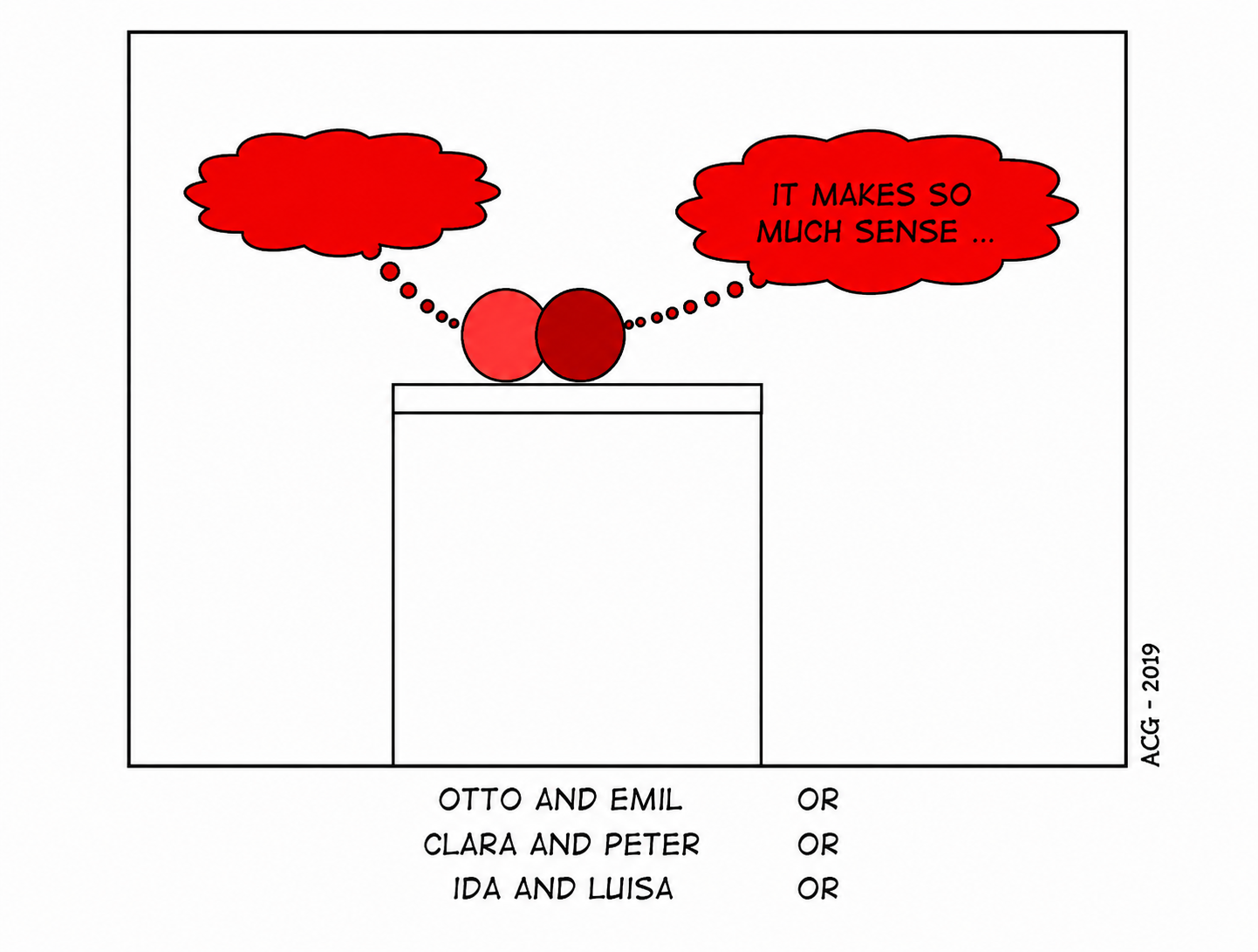
How does meaning arise? After all, everything we see, hear, feel, taste, smell, and perceive as something is imbued with meaning, even if some people consistently maintain that nothing has any meaning. Yet, viewed logically, that is simply impossible. How have these people lost their sense of meaning—lost it so completely that they sometimes choose to end their own lives?
In my view, the perceived meaninglessness must have something to do with connection to oneself and (!) to one's surroundings and the wider world.
Meaning arises in the here and now as soon as an observer generates it. Since meaning does not exist absolutely in the world, an observer must skillfully create it. And what we then call meaning would not exist at all without perceptions (stimuli that are meaningless in themselves) and concepts (meaning generated through repetition). If we had no senses and no concepts to articulate this, life would indeed be meaningless. But fortunately, that is usually not the case. Where it is the case, the task, in my view, is to observe and describe how this comes about in the here and now.
If one follows this line of reasoning, a person's depression must have something to do with how they construct their world in the concrete here and now. Depressive moods, when they are present, are also very concrete. It therefore makes little sense to treat them with medication alone. This may provide temporary relief, but it does not address the underlying causes. A combination of medication and psychotherapy has proven beneficial. In light of the theory that depressive moods have to do with connections (the creation of meaning in the concrete here and now), it makes sense not to look solely at the individual (with depression) but rather to examine the existing or non-existing connections (= linkages).
Meaning arises only through connection and never otherwise.
On Narcissism
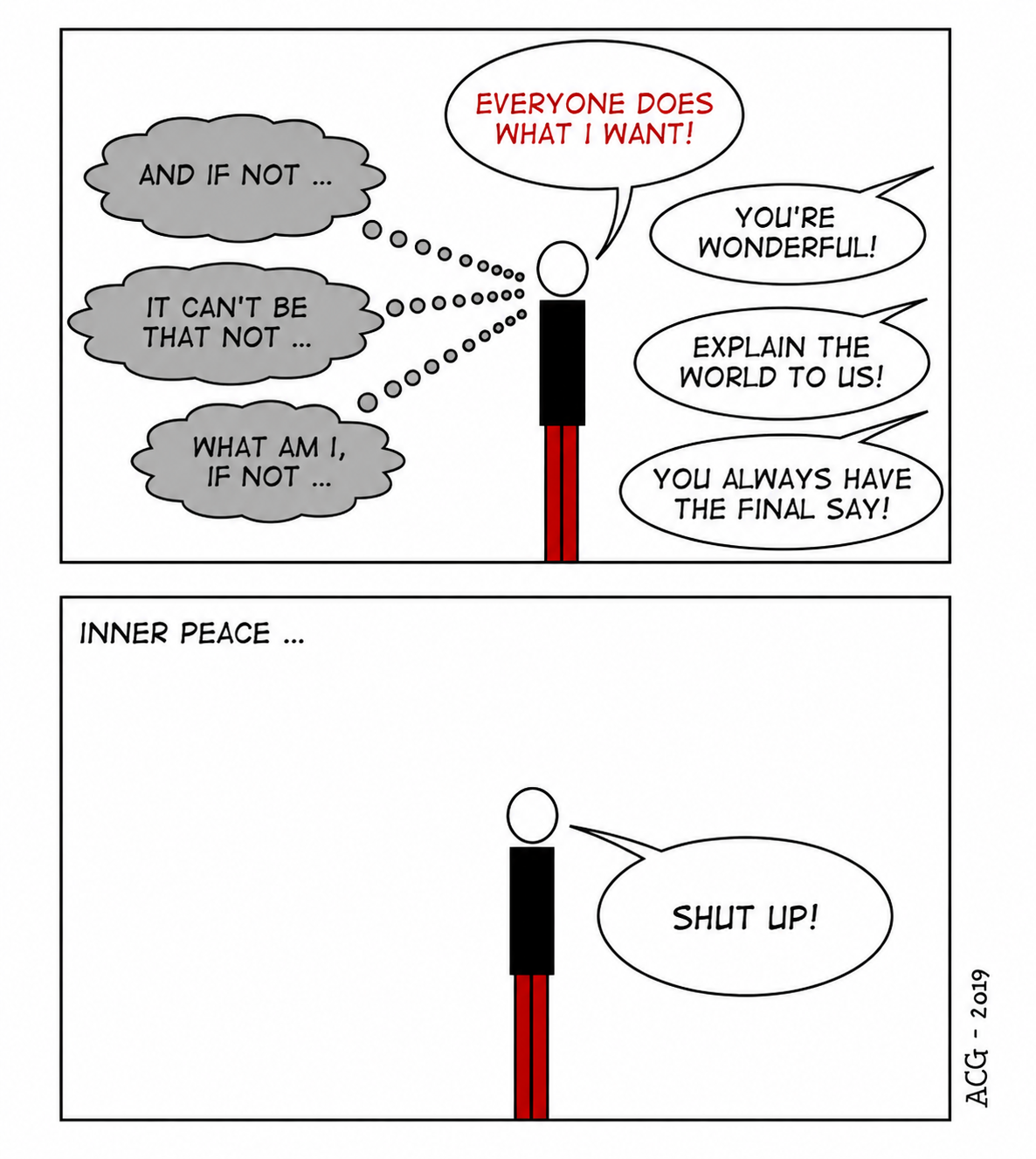
Some people love themselves in a somewhat exaggerated way. If someone wishes to break free from their narcissistic pattern—which, admittedly, is not very likely— it can be helpful to reduce communication with oneself and others to a minimum, because what we generally understand as a narcissistic pattern exists only within communication. Just like any other repeatable pattern. Since narcissism is a form of self-love that cannot exist outside of conceptualized concepts (not in principle, it seems to me), one theoretically only needs to quiet the concepts to cure one's narcissism. In practice, however, given the reluctance that weaning oneself off familiar patterns inevitably entails, this is not quite so easy to implement. And what if the love is then completely gone?
It seems useful to me to strike a balance between realistic and constructivist approaches (even) when dealing with so-called disorders. Of course, there are people with neurotic and/or narcissistic disorders in the here and now. But that does not mean that this cannot change or that these people do not also exhibit non-disordered behaviors. However, this does not alter the fact that in the respective here and now, they can also exhibit neurotic and/or narcissistic behaviors or behaviors that are described as such by others. And in some people, these behaviors predominate in an annoying way. What exactly we mean by the terms "neurotic" or "narcissistic" is a matter of diagnostic criteria that are intersubjectively negotiated and context-dependent. That does not mean they are arbitrary.
If we want something "different" in this world, then we should stop paying attention to narcissists.
On the Power of Language (Not Just in Psychotherapy)
At a certain point, one should stop referring to oneself as a "client" in conversations, namely, for example, when a psychotherapist exclaims, "Oh my God!" or makes similar remarks. This suggests that what is being recounted seems horrific from an outside perspective, whereas for the person involved, it happened years or decades ago and has long since lost its horror. But then one can successfully begin to be horrified all over again.
Therefore, it makes sense for a therapist to first ask what is currently relevant from the perspective of the person with whom one is speaking (also still referred to as a client or patient), and for example, not to ask about catastrophes that are presumably not relevant to the other person in the here and now, but which will then inevitably become relevant again.
Our language has such tremendous power that one should carefully consider every statement before articulating it.
One should be able to expect this especially from psychotherapists, who are paid handsomely for their work, namely for skillfully conducting conversations.
On Attention
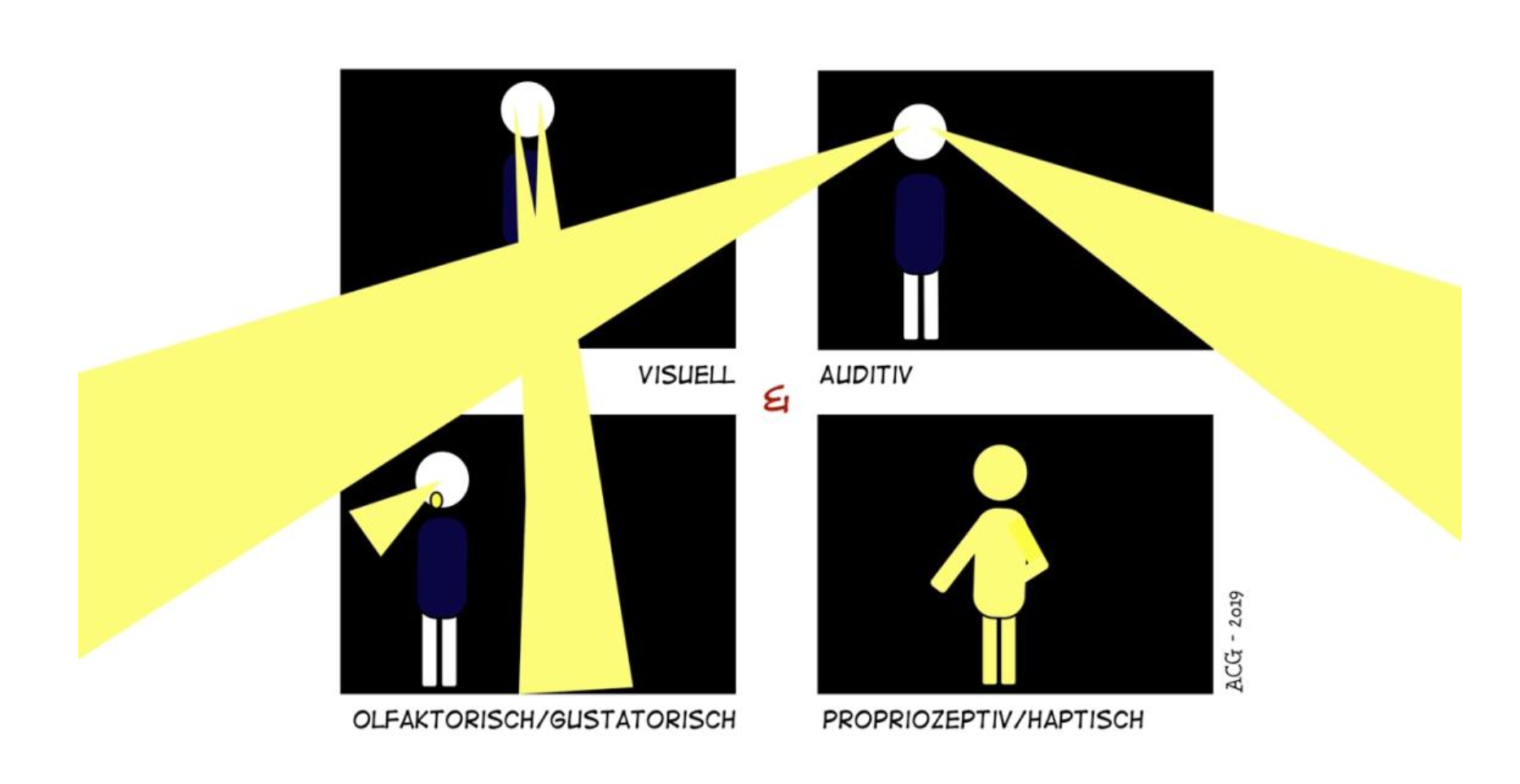
a) visual
b) auditiv
c) olfactory/taste-related
d) proprioceptive/tactile
We usually think of the metaphor of a spotlight when we speak of "attention," and from a constructivist perspective, this makes perfect sense, because a spotlight emanates from the "flashlight," not from the object of observation that one seeks in the "dark monotony." And so we can certainly imagine human attention as light, as an inner force that is directed toward "something" that is brought into focus in the here and now and thus becomes comprehensible in the first place. On the other hand, this "light metaphor" should, of course, also be treated with caution. For we hardly "emit" anything when we look at, touch, or hear something. Rather, we are always also touched by something (by sound waves, by light, by objects/particles/molecules of all kinds).
Attention can therefore only become "attention" at all through interaction with the surrounding world and our fellow beings. Here, too, it is the reciprocity between subject (observer) and object (that which is observed) in a specific here and now that must be considered, and not "attention" "in and of itself."
What seems harmless quickly fades from the spotlight. Therefore, if you want to be noticed (especially after lunch), you should talk about things that aren't so harmless or present harmless topics in a sensationalist way. The more catastrophic something is portrayed, the more likely people are to listen—and the mere fact that they are listening means they are focusing their attention on the speaker.
However, it is also possible (and this is indeed highly remarkable) to divide one's attention.
Our attention is the foundation we need to be able to distinguish one thing from another at all. I see no dichotomy between attention and the ability to conceptualize, the capacity for discrimination.
According to Nilli Lavie's Perceptual Load Theory (1995), our attention is limited. Nor does it increase when we focus on multiple topics at the same time. Nevertheless, we should not think in terms of containers filled with attention, even though we always think in such metaphors. Rather, it makes sense to view the process of conceptualization or discrimination as limited, meaning we cannot attend to too many aspects at once. The fundamentally unlimited number of possible aspects does not change this either.
On Mysticism On Truth
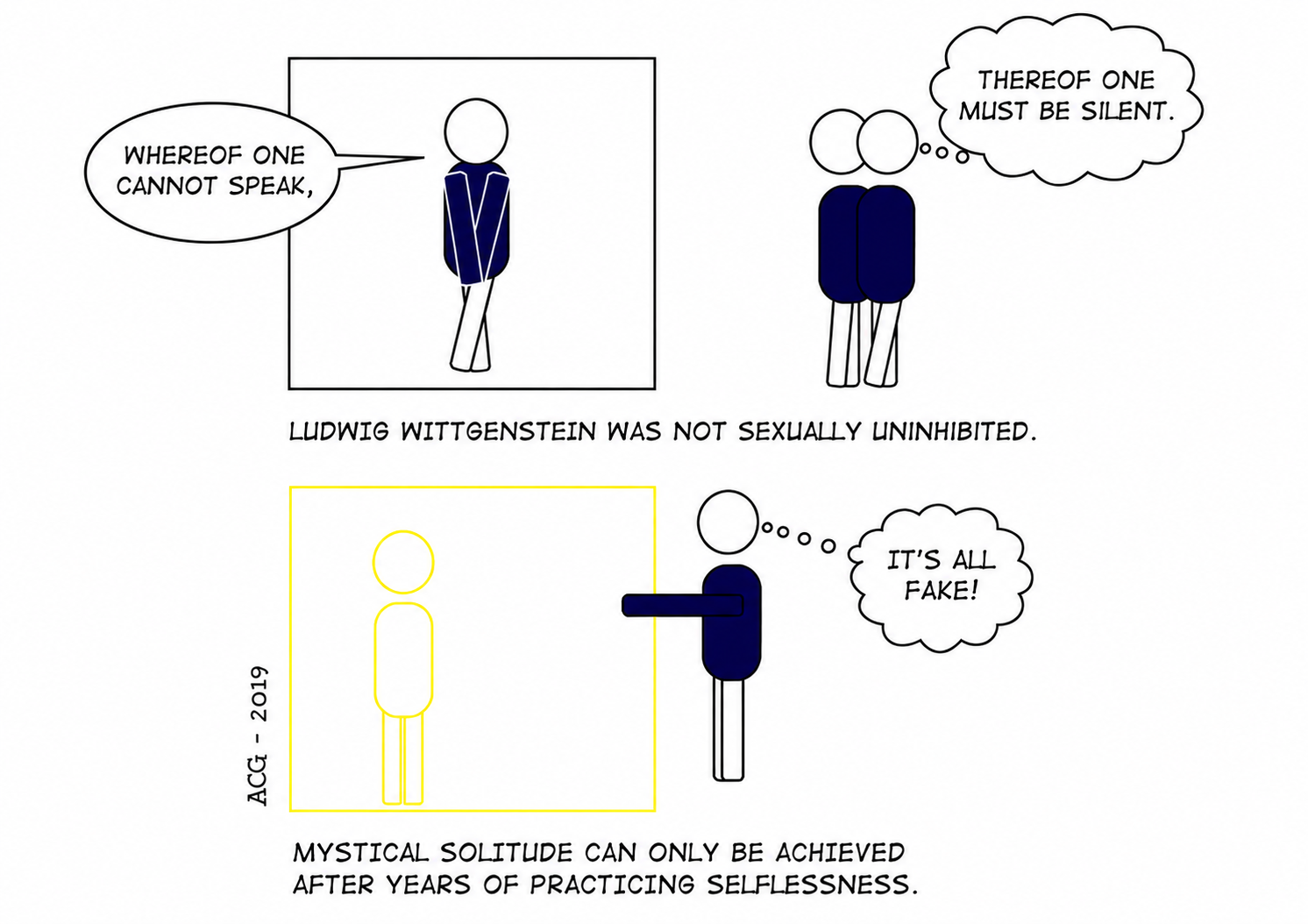
It is not uncommon for mystical experiences to be described as experiences of selflessness, as a sense of oneness, as a dissolution of physical boundaries. Much like the climax of sexual union. However, if one gets stuck in this state, one is definitely a case for the nearest emergency room. It is therefore advisable to be able to re-establish those boundaries at the right moment—for example, before the children come home from school.
On Truth
In radical constructivism according to Ernst von Glasersfeld, the "classical" philosophical concept of truth is abandoned, since, according to this philosophy, there is no need for a "reference" to a reality existing beyond the observer. This ontological premise has become obsolete; rather, the focus is on the fit of the constructs, their viability. That is to say, the question is always how useful constructions are. An extremely pragmatic approach, one might think.
Ernst von Glasersfeld states:
Actions, concepts, and conceptual operations are viable when they fit the purposes or descriptions for which we use them. According to constructivist thinking, the concept of viability in the realm of experience replaces the traditional philosophical concept of truth, which defines a "correct" representation of reality. This substitution, of course, does not alter the everyday concept of truth, which means the faithful repetition or description of an experience. (Glasersfeld 1998, p. 43; translated by ACG)
If I now proceed, following the philosophy of the middle way developed here, on the assumption that our "external reality" is always already grasped conceptually—as soon as we speak of anything, we do not conceptually grasp an "observer's construction," certainly not that of a singular observer, but rather the real world itself. We certainly do grasp this real world correctly, if "correctly" here means that we are capable of making correct statements. A fact that I cannot dispute here without immediately contradicting myself.
To have a language means to be able to formulate correct statements about ourselves and about our immediate surroundings. (Israel 1990, p. 91)
If I do not posit a world beyond our concepts, beyond what is conceptually grasped, then we do in fact grasp the real world in the here and now. And there is no other world behind it. Nothing, then, that we cannot grasp. Nothing that does not reveal itself to us. And nothing to which we merely refer linguistically. I would therefore, in keeping with constructivism, speak of relative truths in language that exist as long as they prove useful. "Absolute" truths (outside of conceptual understanding) are not conceptually graspable and need not concern us in language either.
And yet, relative and absolute "truth" are ultimately indistinguishable.
On the Nature of the Mind
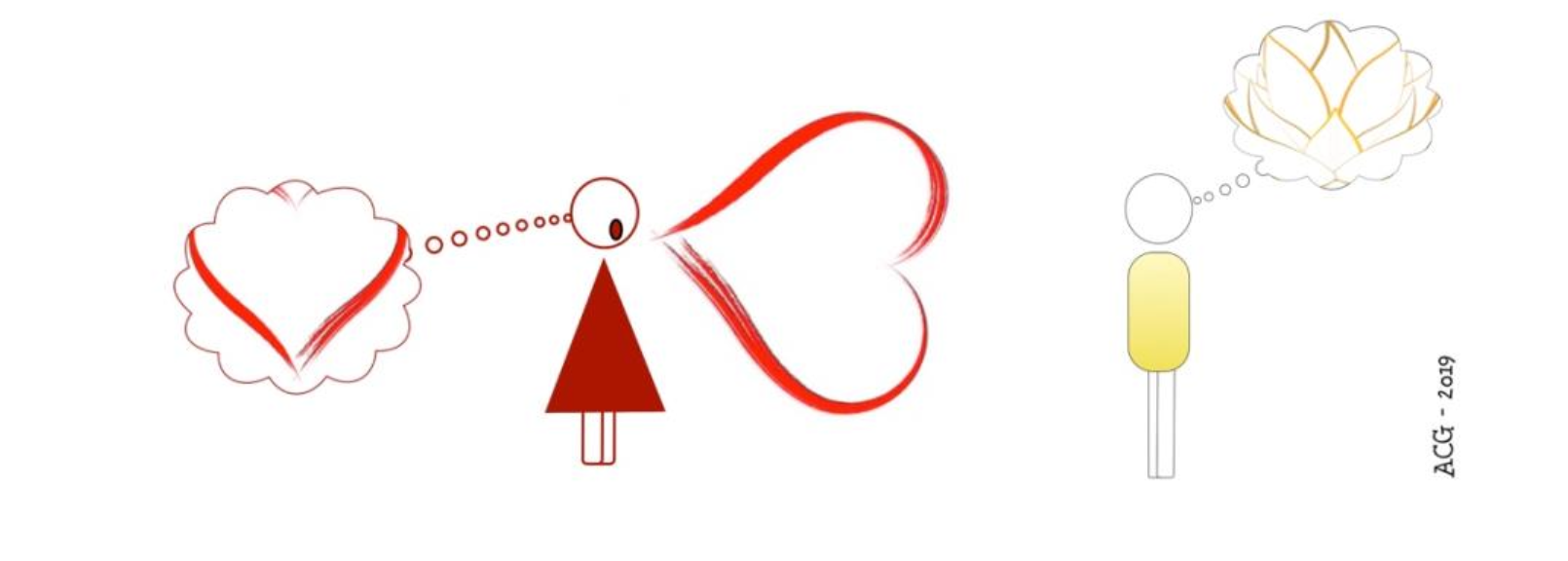
In Buddhist philosophy, as Sogyal Rinpoche writes, "the breath, or Prāna in Sanskrit, is regarded as the 'vehicle of the mind,' because Prāna gives our mind mobility. So when you calm the mind by skillfully working with the breath, you automatically train and tame it at the same time (Rinpoche 2010, p. 97). As soon as we speak, we mentally form a figure. And even when we think (by which I mean inner speech), we physically form a figure, even if it is the "figure of the body." The controlling entity is the "I," which is likewise constructed through thought. Where the "I" begins to dissolve, because we deconstruct it as an embodied, conceptual construct, free from absolute existence, there is no longer a controlling authority. Logically speaking (free from an "I"), there is also no one who could conceptualize a "body." It is obvious that the "I" and also the "body" do not necessarily allow this to happen to them willingly (who would willingly lose their existence?). If I wish to explore my mind (you can hardly explore my mind), I can nevertheless venture into the deconstruction of my "I" and experimentally explore what I then experience.
If you do the same, we can talk about our experiences tomorrow (if you'd like) and see if there are any similarities. Fortunately, many people have already gone down this path and have written down their experiences. But it's always better to gain your own experiences rather than just taking others' at face value.
On Consciousness
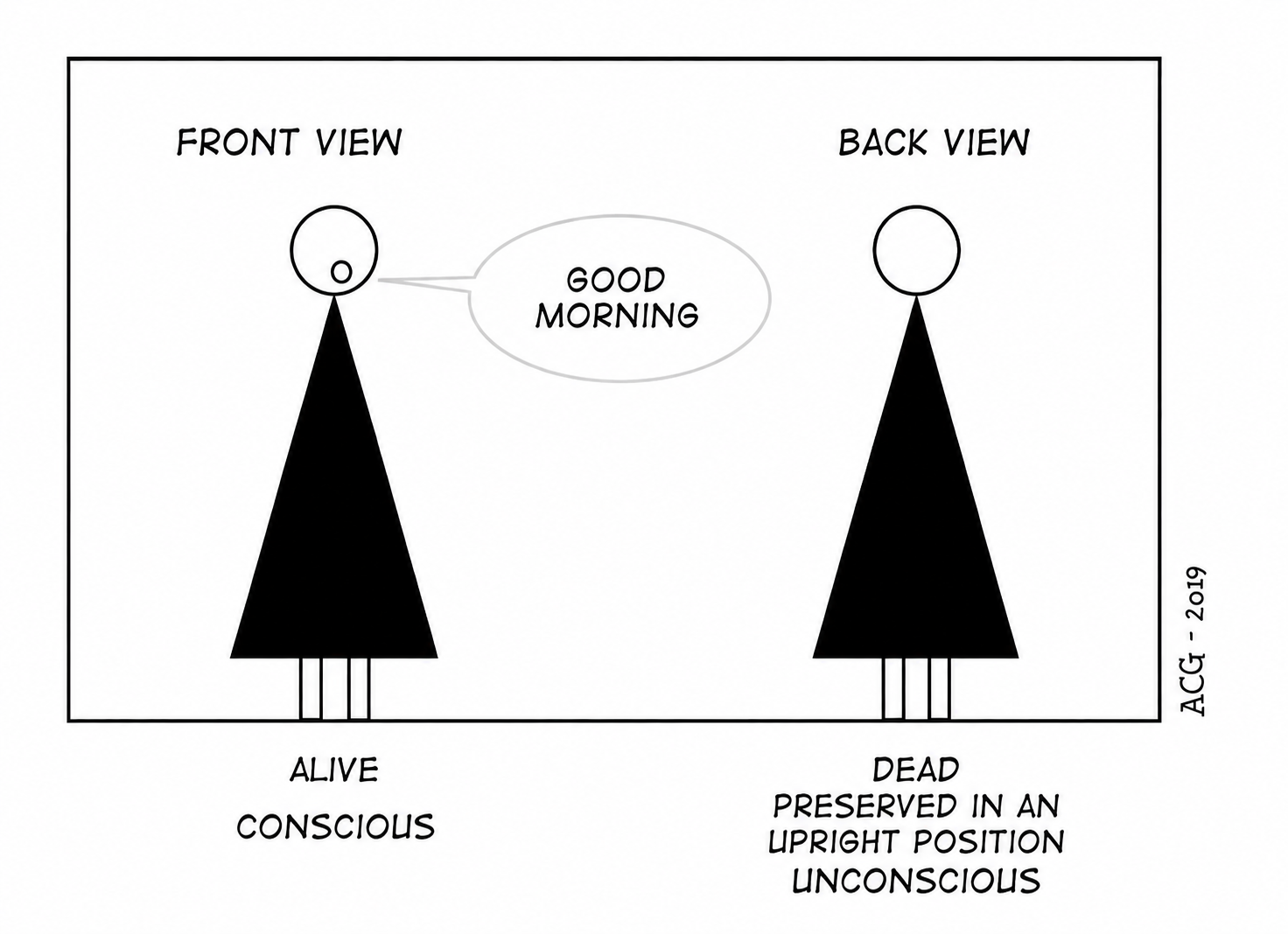
I have already written quite a bit about the "psyche" and attempted to reconstruct its "existence" as a linguistic concept that can certainly be useful (even in a "coupled version," as some theorists like to frame it). Of course, this says nothing about the content of consciousness. Let's think of a dream. So what exactly "is" this content of consciousness that appears in the dream, sometimes highly real and well lit, before the "inner eye"? In my view, contents of consciousness are concepts (embodied patterns). But does that really explain the experience per se? It is, after all, quite peculiar that one can "have" a thought or a feeling at all—indeed, that I am capable of thinking at all (if one wishes to call what I am doing here that).
I think that here (despite all my love for deconstruction and reconstruction) there remains a part that remains in the dark, one that cannot be explained through embodied and repeatable patterns. Just as I do not understand the phenomenon of "light" (in and of itself), even though I can, of course, study physical descriptions of this "light." Must I, or do I want to, understand "everything"? As far as consciousness (and "light") is concerned, a part of it is beyond my grasp or comprehension. And may it remain, at least for me, a mystery.
On the Self
It is not a supposedly "operationally closed nervous system" that prevents revolutions in thinking or the acceptance of something new, but rather the human ego, which stubbornly closes itself off to the thoughts of others. But this ego is easy to reach. For example, it always responds to flattery. It is powerless when it comes to love and affection. For the human (and animal) organism always tries to avoid any form of discomfort (pain). This basic principle applies almost always. There are also situations that require pain (discomfort) so that one can then return to a "neutral" (neither-nor state) or—even better—a pleasurable state. Children, for example, do not yet understand this very well, especially when they have to be "pricked" so that the appropriate medicine can subsequently be administered to them.
Of course, it's nice to surround yourself with people who fawn over you, who constantly tell you how great you are. And woe betide anyone who dares to criticize the emperor (of radical constructivism—just to give a trivial example). First, that person is warned (yellow card), then they are either ignored (which usually works) or (if that isn't enough) verbally attacked (as we all know, attack is the best defense). Because what must not be cannot be. If one wants to successfully "infiltrate" such a system (= break it open), it is advantageous to employ the flattery tactic until one is "inside" (the Trojans already knew this, but before them, the Greeks). For one can only change a system from within, not from without.
One World

We have only this one world.
There is no better world beyond it.
It is not a will-o'-the-wisp, but is to be understood—and is understood—as highly real, in the here and now. At least as long as I am alive. Every perceived form is subject to the observation of an observer who shapes it into that form.
Since we (ourselves) as observers cannot not observe, unless we are dead, we cannot answer the question of what the "world" or the "universe" is when no one is looking.
What we can say is that it certainly cannot be "this world" and not "this universe," since "this universe," as I am currently conceiving it, exists only because I (and many other observers) conceptually shape it intersubjectively in a certain way.
There is no more real world behind this world. We do not merely "approach" a reality descriptively, but we create this reality by conceptually grasping it as this reality in every moment in the here and now.
Bibliography
Anders, G. (1993): Philosophische Stenogramme. München (Beck).
Bateson, G. (1997): Geist und Natur. Eine notwendige Einheit. Frankfurt a. M. (Suhrkamp).
Christoph-Gaugusch, A. (2018): DemenZen und die Kunst des Vergessens. Fünf Schritte für mehr
Gelassenheit im Umgang mit Demenz. Heidelberg (Carl-Auer).
Christoph-Gaugusch, A. (2020): Philosophie eines mittleren Weges. Wien (Passagen).
Ciompi, L. (2019): Affektlogik. Über die Struktur der Psyche und ihre Entwicklung. Heidelberg
(Carl-Auer).
Foerster, H. v. (1985): Sicht und Einsicht. Versuche zu einer operativen Erkenntnistheorie.
Braunschweig/Wiesbaden (Vieweg).
Glasersfeld, E. von (1998): Radikaler Konstruktivismus. Ideen, Ergebnisse, Probleme. Frankfurt
a. M. (Suhrkamp).
Hayward, J. W. u. Varela, F. J. (1998): Gewagte Denkwege. Wissenschafter im Gespräch mit
dem Dalai Lama. München (Piper).
Israel, J. (1990): Sprache und Erkenntnis. Zur Logischen Tiefenstruktur der Alltagssprache.
Frankfurt/New York (Campus).
Keller, H. (1907): Die Geschichte meines Lebens. Stuttgart (Robert Lutz).
Lavie, N. (1995): Perceptual Load as a Necessary Condition for Selective Attention. Journal of
Experimental Psychology, 21 (3), 451 – 468.
Maturana, H. R. u. F. J. Varela (1987): Der Baum der Erkenntnis. Bern (Scherz).
Pöppel, E. (2000): Grenzen des Bewußtseins. Wie kommen wir zur Zeit, und wie entsteht
Wirklichkeit. Frankfurt a. M./Leipzig (Insel).
Ramachandran, V. S. a. E. M. Hubbard (2001): Synaesthesia – A Window Into Perception,
Thought and Language. Journal of Consciousness Studies, 8 (12), 3 – 34.
Rinpoche, S. (2010): Das tibetische Buch vom Leben und vom Sterben. Ein Schlüssel zum
tieferen Verständnis von Leben und Tod. München (Droemer Knaur).
Simon, F. B. (2017): Meine Psychose, mein Fahrrad und ich. Zur Selbstorganisation der
Verrücktheit. Heidelberg (Carl-Auer).
Simon, F. B. (2018): Formen: Zur Kopplung von Organismus, Psyche und sozialen Systemen.
Heidelberg (Carl-Auer).
Simons, D. J. a. C. F. Chabris (1999): Gorillas in our midst: Sustained inattentional blindness for
dynamic events. Perception, 28, 1059 – 1074.
Stierlin, H. (1994): Individuation und Familie. Studien zur Theorie und therapeutischen Praxis.
Frankfurt a. M. (Suhrkamp).